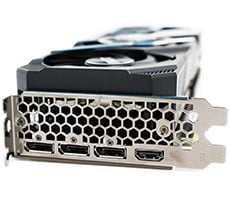
ASUS Radeon R9 270 Direct CU II Review

|
|
|

|
|
Metro Last Light is your typical post-apocalyptic first person shooter game with a few rather unconventional twists. Unlike most FPS titles, there is no health meter to measure your level of ailment; rather, you’re left to deal with life, or lack thereof, more akin to the real world with blood spatter on your visor and your heart rate and respiration level as indicators. Metro Last Light boasts some of the best 3D visuals on the PC platform and includes a DX11 rendering mode that makes use of advanced depth of field effects and character model tessellation for increased realism. This title also supports NVIDIA PhysX technology for impressive in-game physics effects. We tested the game at resolutions of 1920x1200 and 2560x1600 with its in-game image quality options set to their High Quality mode, with DOF effects disabled. |


The GeForce GTX 660 climbed the ladder a bit in the Metro Last Light benchmark, but ultimately the Asus Radeon R9 270 DirectCU II still came out ahead but a few percentage points.
;)
;)
Click To Enlarge
There were not major anomalies to report according to our FCAT results either. The low-end Radeon R7 260X and Radeon HD 7790 shows some significant frame time variation in the middle of the run, but the higher end cards all performed similarly, with each one showing a handful of frame time spikes, i.e. stutter.