AMD Spider Platform - Phenom, 790FX, RV670


On the surface, AMD’s new Phenom processors look just like current Athlons. The processors use the same packaging and have the same pin configuration. Underneath that unassuming heat-spreader, however, lays a quad-core die based on the Agena core.
;)
;)
An AMD Phenom 9700 Processor
We should note that retail-ready Phenom processors will have different markings than what you see pictured above. The CPU you see here is an AMD engineering sample 2.4GHz Phenom 9700 that hasn’t been laser etched with the same brandings as a retail-ready processor. Retail-ready Phenom processors have markings much like current Athlons with the model numbers and other identifying information.
;)
;)
Details from CPU-Z with the Phenom 9700
The latest version of CPU-Z shows many of the details we laid out on the previous page. As you can see, the processor is based on the Agena core with socket AM2+ packaging. Our particular chip is stepping ‘2’ and supports all of the instructions sets listed in the aptly names ‘instructions’ section. The processor’s L2 cache configuration is 16-way set associative, but the shared L3-cache is 32-way set associative.
 |
|
We know many of you are wondering just how much clock speed headroom our Phenom 9700 has left under the hood, so we spent some time overclocking our chip using a Gigabyte 790FX-chipset based motherboard. We simply upped the processor voltage and increased the HT link frequency until our test machine was no longer stable. A stock AMD PIB heatsink was used.
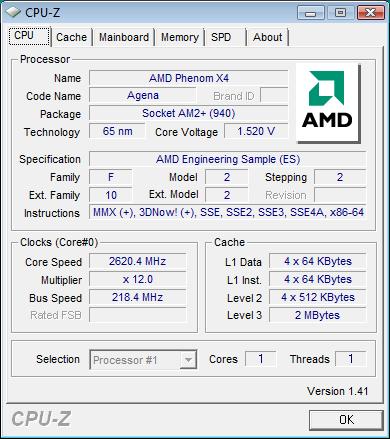
We tried various different voltages and memory settings, and unfortunately were only able to take our particular sample up to 2.62GHz – an increase of 220MHz, or 9.2%. We must stress that our chip was an engineering sample and our overclocking results may not be indicative of actual retail product. We hope this is the case, because as you’ll see a little later on, AMD is going to have to ramp clock speeds up considerably to compete with the performance of Intel’s high end quad-core processors.