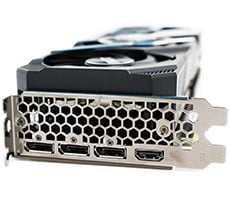
AMD Radeon R9 Nano Review: Small But Mighty Fiji Unleashed

Before bringing this article to a close, we'd like to cover a couple of final data points -- namely, power consumption and noise. Throughout all of our benchmarking and testing, we monitored acoustics and tracked how much power our test system was consuming using a power meter. Our goal was to give you an idea of how much power each configuration used while idling and also while under a heavy workload. Please keep in mind that we were testing total system power consumption at the outlet here, not the power being drawn by the graphics cards alone.
|
|


At idle, all of the graphics cards we tested used similar amounts of power, give or take just a few watts. Under load, however, the field really spreads out. The Radeon R9 Fury X topped the chart, followed by its air-cooled counterpart, the R9 Fury. With the Radeon R9 Nano at the heart of our test rig, it consumed over 90 fewer watts than the Fury X--AMD's specified power ratings are in-line with our testing. And with power consumption so (relatively speaking) low, temperatures on the R9 Nano are a non-issue. The cooler on the card kept the GPU running in the low 30's at idle. And under load playing actual games the GPU temperature typically hovered in the mid-to-high 70's.

In terms of its noise output, the Radeon R9 Nano also proved to be relatively quiet. According to our noise meter, it made a touch more noise than the Fury X, but overall, its cooler can definitely be considered quiet. We did, however, experience quite a bit of inductor noise with our card under load. Noticeable clicks and squeals could be heard emanating from the card, and we're told this isn't something isolated to our sample. We always test GPUs in a chassis, but often have the side-panel off. With the system closed up and under a desk, the noise isn't nearly as noticeable, and with headphones on or a game playing at a decent volume it won't be very audible, but we need to point it out nonetheless.