AMD Radeon HD 7950 Tahiti Pro DirectX 11 GPU Review

With AMD touting the overclockability of the Radeon HD 7950, we were curious to see how much frequency headroom the card had left in the tank, with a 4+ billion transistor, ultra-complex 28nm GPU under the hood. So, for our next set of performance metrics, we spent some time overclocking the new Radeon HD 7950 using the Overdrive utility built into ATI's Catalyst drivers.
 |
|
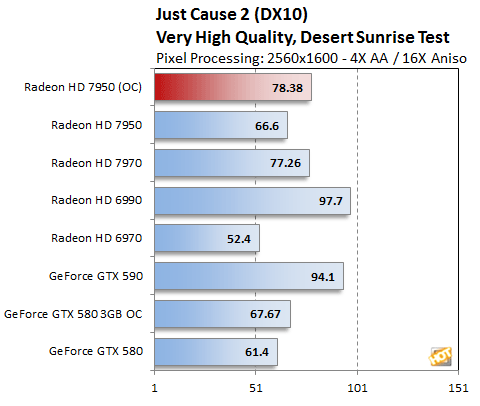

For these tests, we simply cranked PowerTune up to the +20 mark and increased the GPU and memory frequencies until we saw visual artifacts or our test system exhibited instability. Turns out, the Radeon HD 7950 had no trouble whatsoever running at a GPU clock of 1.05GHz with 1275MHz memory. Although, in all honestly, we’re pretty sure there was some more headroom left in the memory, but due to time constraints we ran with these numbers.
With the Radeon HD 7950’s GPU overclocked to over 1GHz, it put up numbers somewhat better than the Radeon HD 7970 in the JC2 benchmark and just missed the mark set by the higher-end card in AvP. All told, performance increased by a respectable 15% - 17.6% with some simple tweaks. With more extensive cooling and tweaking, we’re confident even higher frequencies will be possible with the Radeon HD 7950.
While testing, we also spent some time monitoring noise and temperatures under various workloads and found the Radeon HD 7950 to be quieter than the 7970, but not quite as quiet as NVIDIA’s offerings. The Radeon HD 7950’s quieter operation is due to the card’s much lower stock frequency. Shave 125MHz off the top and disable a few functional blocks in the GPU and it’s no wonder the 7950 is somewhat more subdued acoustically, versus its higher-end counterpart. Temperatures were also pretty good. The Radeon HD 7950 idled at 43’C and peaked at 74’C. Although these numbers aren’t that far off from other high-end GPUs, what we did notice about the 7950 was that it was much cooler to the touch after prolonged use. The Radeon HD 6970, for example, was almost untouchable after a couple of hours in the test bed. The Radeon HD 7950, however, was warm (obviously) but was easy to handle.