



Why A Giant Iron Bar Inside The Ring Nebula Could Reveal The Fate Of Earth


Led by a team from University College London (UCL) and Cardiff University, the discovery essentially uncovered a feature hidden in plain sight for over two centuries. The Ring Nebula, located 2,600 light-years away in the constellation Lyra, is one of the most photographed objects in the night sky, with its glowing shroud of gas expelled by a dying, sun-like star. Yet, while telescopes like James Webb have captured its intricate shells in breathtaking detail, it took a new instrument called WEAVE (WHT Enhanced Area Velocity Explorer) on the William Herschel Telescope to reveal this metallic anomaly.
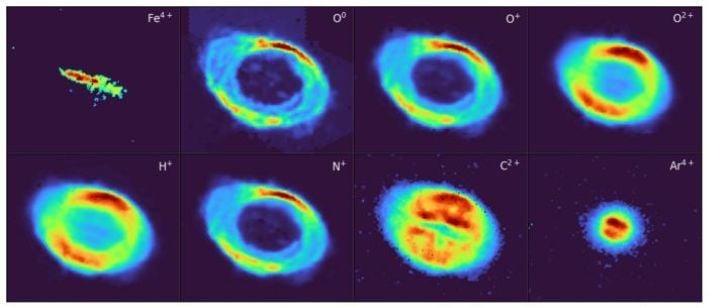
This strip or bar of iron is quite staggering in scale, stretching across the nebula’s interior roughly 1,000 times the distance between the Sun and Pluto (3.7 trillion miles), with mass of the iron atoms estimated to be comparable to Mars. This narrow strip of ionized iron appeared "as clear as anything" when the data was processed, according to lead author Dr. Roger Wesson. The structure remained invisible for decades because previous observations focused on the nebula’s overall glow; it was only by mapping the light spectra (using WEAVE's Large Integral Field Unit) at every single point across the nebula that this specific chemical signature could be isolated.
It's still up in the air as to what the iron bar is, though. One theory suggests the iron is the remains of a rocky planet that was once part of the central star’s solar system. As the star ran out of fuel and bloated into a red giant, it likely engulfed and vaporized its inner planets. The iron bar could be the ashes of such a world, stretched into a long arc of plasma by the star’s final death throes.
Alternatively, the bar might simply represent an entirely new way that dying stars eject their material. For now, the team is calling for more detailed observations to see if other elements are lurking alongside the iron, which could confirm the dead planet hypothesis.
Photo credits: UCL/WEAVE





