



Elon Musk Says Terafab Mega AI Chip Factory Will Be The Largest Ever Built


Elon Musk’s latest industrial gambit, called Terafab, aims to interrupt the semiconductor supply chain by building a massive $25 billion chip fabrication facility in Austin, Texas. As a joint venture between Tesla, SpaceX, and xAI, the ambitious project has ambitions of producing a terawatt of computing power yearly to fuel Musk’s most ambitious AI and aerospace dreams.

Between grandiose lead-ups about the sun's power potential and "starting a galactic civilization," Musk's plan is difficult to overstate. For one, Terafab is targeted to produce a million wafer starts per month, a figure that would represent roughly 70% of TSMC’s entire global output. Musk justifies the need for such a behemoth by arguing that existing suppliers cannot expand fast enough to meet his specific requirements. Tesla alone reportedly needs 100 to 200 gigawatts to power its Full Self-Driving software and the Optimus humanoid robot program.
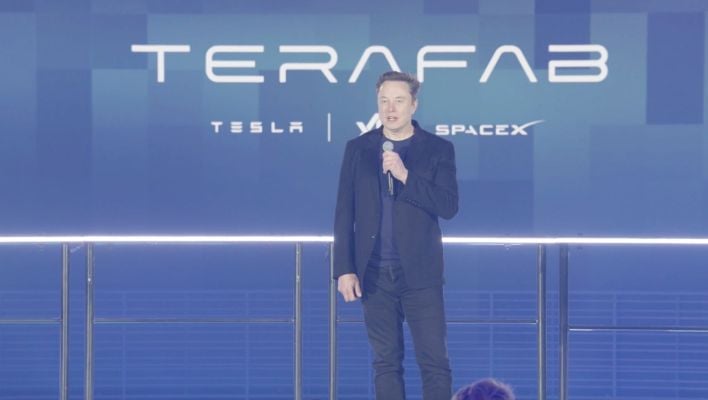
That said, Musk intends to direct 80% of Terafab’s output toward space-based AI satellites. He argues that the vacuum of space provides a superior environment for thermal scaling and that orbital solar irradiance is five times more potent than on Earth, making space-based data centers cheaper than terrestrial ones within three years. To facilitate this, the fab will produce two distinct types of silicon: terrestrial inference chips for cars and robots, and D3 chips specifically hardened for the radiation and heat of space.
Of course, semiconductor fabrication is notoriously unforgiving, requiring ultra-clean environments and specialized expertise that neither Tesla nor SpaceX currently possesses at a mass scale. Critics point to Tesla's FSD delays, Hyperloop cancellation, and the rocky rollout of Tesla’s 4680 battery as reminders of Musk overestimating his ability to disrupt the system. While Musk has promised small-batch production of the fifth-generation AI5 chip as early as 2026, the financial burden is immense. Analysts estimate the total cost of realizing this vision could eventually balloon up to $300 billion.
Photo credits: Terafab





