



Super Star Torn To Pieces By Black Hole Releases Energy Equal To 400 Billion Suns


Astronomers have captured the moment a supermassive black hole literally tore apart a super sun (one 30 times larger than our own) and released a burst of energy equivalent to 400 billion suns.
Affectionately called the "Whippet" (officially AT2024wpp), this Tidal Disruption Event (TDE) occurred on a scale that defied traditional expectations. While it's fairly normal for stars to occasionally wander too close to black holes (and be devoured in the process), the sheer magnitude of this specific explosion makes it one of the most energetic cosmic events ever recorded, dwarfing even the most powerful known supernovae.
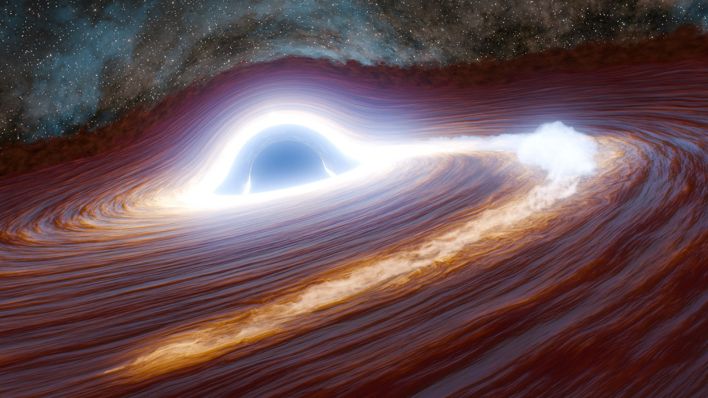
The event was first flagged by the Zwicky Transient Facility in California and subsequently studied by an international team using NASA’s Swift satellite and the Liverpool Telescope in the Canary Islands. What they found was the black hole’s immense gravitational pull stretching and compressing the star into a long, thin strand of stellar plasma. As this material spirals inward to form an accretion disk, the black hole blasted out shockwaves that were clocked traveling at 20% the speed of light (roughly 134 million miles per hour) as they slammed into surrounding gas.
Interestingly, the presence of moving helium could mean that the star in question may have been a Wolf-Rayet star, a massive and highly evolved type of star that had already shed its outer hydrogen layers before its final, fatal encounter.
This particular TDE is significant not just for its power, but for its unusual characteristics. Scientists noticed a radiant blue glow and a specific X-ray signature that resembles a Luminous Fast Blue Optical Transient (LFBOT), a mysterious class of bright, brief explosions. The high temperatures and extreme luminosity hints that the black hole at the center is potentially hundreds of millions of times the mass of our sun. As it devoured its solar snack, the resulting flare remained visible for months.
Are we the only ones who got this song stuck in our head when reading about a "Whippet?"





