



Black Holes Defy Stellar Laws With Impossible Mergers & Scientists Finally Know How


Seven billion light-years away, an astronomical event in 2023 sent a buzz through the astrophysics community. Gravitational wave detectors registered the merger of two black holes (a collision designated GW231123). The detection itself was not unusual, but the characteristics of the merging objects were. Both black holes were colossal, boasting masses roughly 100 and 140 times that of the Sun, and both were spinning at near light speed. The sheer existence of these behemoths was immediately flagged as impossible—for one, they fell squarely within the pair-instability mass gap. However, a team of researchers from NY have a different proposal.
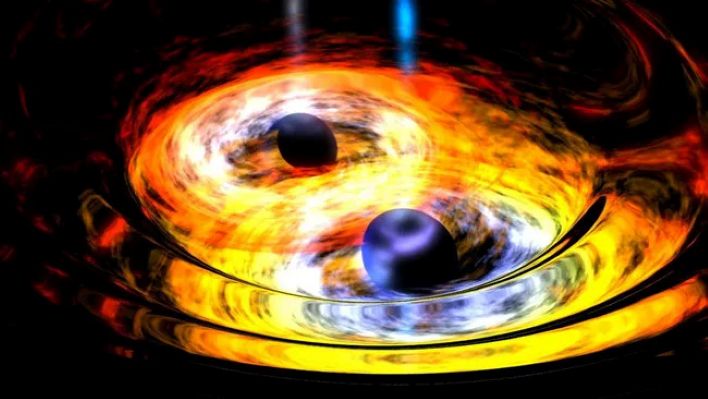
Initial theories speculated that these forbidden black holes could be second-generation objects, formed from prior, smaller black hole mergers. However, that process is known to scramble the spin of the resulting daughter black hole, yet the two objects in GW231123 were found to be rotating at maximum velocity. This highly specific combination of extreme mass and rapid rotation pointed toward an entirely different mechanism of collapse.
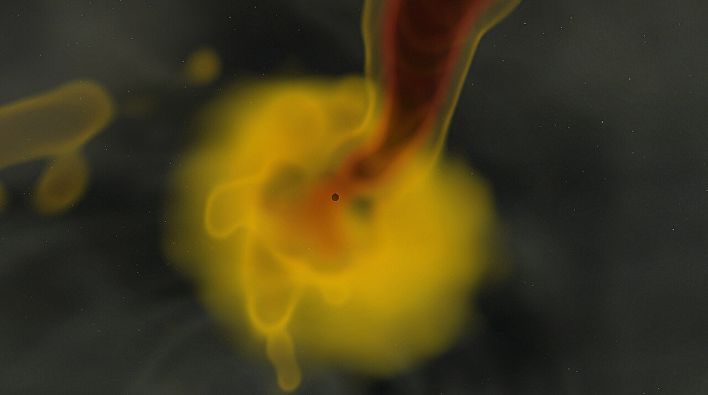
The solution arrived through the work of a team of astrophysicists led by Ore Gottlieb at the Flatiron Institute’s Center for Computational Astrophysics, who decided to include an often ignored factor into their simulations: magnetic fields. By running complex computer models that tracked the life cycle/death of giant stars — such as a star 250 times the mass of the Sun that eventually slimmed down to 150 solar masses — the team found that the aftermath of the collapse was not a simple consumption of stellar debris.
When a rapidly spinning star collapses, the leftover material forms a rotating disk around the newborn black hole. In the presence of strong magnetic fields, this disk is not entirely accreted. Instead, the fields act like powerful levers that generate pressure that blasts up to half of the stellar remnant away from the black hole at nearly the speed of light. This expulsion drastically limits the amount of mass the nascent black hole can gain, effectively "slimming it down" into the forbidden mass gap while its core rotation accelerates its spin to near-maximal levels.
Gootlieb and team also found that the formation of these black holes should be accompanied by short, detectable bursts of gamma rays, providing astronomers in the future with a new observational target to confirm this new theory.
Main photo credit: LIGO





