



Skeptics Slam Valve’s Steam Machine Specs But Don't Count It Out


What Are The Valve Steam Machine's Specifications?
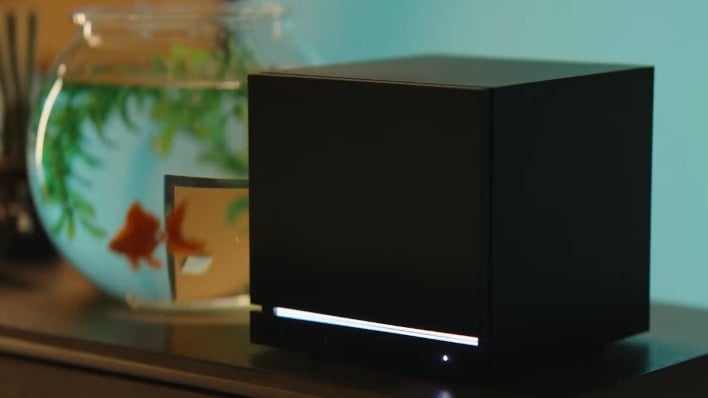
Described as a "six-inch cube", the Steam Machine is compact vs. the PS5 and indeed most SFF PCs.
- CPU: "Semi-custom" AMD Zen 4 CPU with 6 cores, 12 threads at up to 4.8 GHz and 30W TDP
- GPU: "Semi-custom" AMD Radeon RDNA 3 GPU with 28 Compute Units at up to 2.45 GHz and 110W TDP*
- RAM: 16GB of DDR5 RAM
- VRAM: 8GB of GDDR6 RAM
- Storage: Pre-Installed NVMe SSD (512 GB or 2TB depending on model), SDXC SD Card and USB 3.2 Gen 2 storage support
- I/O: 1 HDMI 2.0 port (up to 4K 120Hz), 1 DisplayPort 1.4 port (Up to 4K 240Hz or 8K 60Hz), 4 USB Type-A ports (Two front 3.2 Gen 1, Two rear 2.0), 1 Rear USB Type-C 3.2 Gen 2 port, 1 Gigabit Ethernet port,
- Wireless Support: Wi-Fi 6E 2x2, Bluetooth 5.3, Steam Controller (Proprietary 2.4G RF)
- Operating System: SteamOS
- Dimensions: 156 mm x 162.4 mm x 152 mm (L x W x H)
- *Note: Early reports indicate that the GPU is also being tested at up to 130W TDP, so this may change or be overclockable in the final unit.
The specifications of the Valve Steam Machine are surprisingly modest for a new "console" announced in 2025. These are certainly not "PS5 Pro" or "PlayStation 6" comparable specs, with a six-core Zen 4 chip or a 28-CU RDNA 3 GPU. Some are even claiming that these specifications put the Steam Machine beneath the base PlayStation 5, but they're only partially correct. The PlayStation 5 has 36 RDNA 2 Compute Units, versus the Steam Machine's 28 RDNA 3 Compute Units. While there are architectural improvements in RDNA 3 over RDNA 2, the Steam Machine is still going to fall behind the PlayStation 5 in terms of peak graphics performance for many workloads.
How Do The Valve Steam Machine Specs Compare To PlayStation 5?

Valve footage of Black Myth: Wukong running on Steam Machine.
Valve claims Steam Machine Verified titles will run at "4K 60 FPS with FSR enabled".
That discrepancy in graphics horsepower doesn't tell the entire story for the Steam Machine versus the PlayStation 5, though. Another factor that must be considered is the CPU. There's a two-generation bump between the PS5 (and PS5 Pro)'s 8-core AMD Zen 2 CPU and the Steam Machine's 6-core Zen 4 configuration. The CPU processing horsepower, which mostly determines the maximum achievable framerate in a given game before the GPU comes into play, is in the Steam Machine's favor.
AMD's Zen 4 architecture offers better instructions per clock (IPC) and higher clocks in comparison to Zen 2, and those two things can have a huge impact on gaming performance. Also, on the previous-generation PlayStation 4, two of the CPU cores were locked down for system tasks. While nobody has confirmed or denied a similar situation on the PlayStation 5, it's not often that games make use of all eight cores in any case. With that in mind, six, higher-clocked Zen 4 cores should be able to beat eight Zen 2 cores by a considerable margin. And thanks to the flexibility to tweak game settings on the PC, targeting 120 Hz may be much more realistic on the Steam Machine than current-gen PlayStation hardware—albeit not at 4K or with high image quality settings.
If Valve's advertising holds true, there's also evidence to support that the Steam Machine is running games more smoothly at 4K 60 FPS (with the help of AMD FSR) than the base PlayStation 5's various upscalers-sans-PSSR. Black Myth Wukong and Metal Gear Solid Delta: Snake Eater, for example, both highlighted by promotional material, would make for truly remarkable 4K 60FPS achievements on the Steam Machine, and wouldn't be matched by a base PS5.
Why Did Valve Pick This Hardware?
All of this still raises a question, though. If Valve's goal is to target living room console gaming at 4K60 (with the help of upscaling), why skimp on the hardware? A couple of extra AMD Zen 4 cores or GPU Compute Units certainly wouldn't have hurt, right? While those changes would certainly have made the Steam Machine more powerful and make it seem more appealing on paper, it may have made hitting its price targets and compact form factor much more difficult.
Besides showing that SteamOS is making big strides in popularity, the latest Steam Hardware Survey also shows that the median Steam gaming PC features six CPU cores and a humble last-gen, entry-level GPU, with modest memory and storage. While there is a vocal portion of PC gamers that demand the latest and greatest hardware, the overwhelming majority are budget conscious "gamers" who do, in fact, just want to have fun and play games, and are far less concerned about whether the experience is the best it can be -- cost be damned.
Will Valve's Steam Machine Succeed?
At this stage, it's too early to say whether the Steam Machine will succeed. Even if it proves to be as anemic as skeptics claim, a low enough price point or an affinity for Valve and/or Steam Sales may wind up carrying it over the finish line anyways. Having evaluated the hardware in question, and making some reasonable estimates based on other things we know—like the potential for driver-level AMD FSR 4 support (via a Valve comment to Digital Foundry)—we are cautiously optimistic. Not everyone on the HotHardware team is quite as excited about the Steam Machine, but Valve has impressed some of us enough at this point to believe that the new SteamOS device will be a much bigger success than Valve's first attempt.




