



Scientists Pinpoint Milky Way's True Outer Boundary and It's Closer Than Thought


This study, led by Karl Fiteni (and recently published in Astronomy & Astrophysics) used ages from more than 100,000 giant stars plus data from the LAMOST-DR3 and APOGEE-DR17 surveys and the Gaia spacecraft, to map how stellar ages change across the disk. In a galaxy like ours, stars generally form from the inside out, so the farther you move from the center, the younger the average stars should be. Or only up to a point, anyway.
By modeling the gravitational reach of the Milky Way, scientists identified a specific radius where the density of matter drops off precipitously. This point, known as the virial radius, marks the outer limit of the galaxy’s gravitational dominance. Instead of fading smoothly, the age pattern bends into a U-curve. Stars get younger with distance from the center, then older again beyond the boundary, a reversal that points to a sharp drop in star formation efficiency.
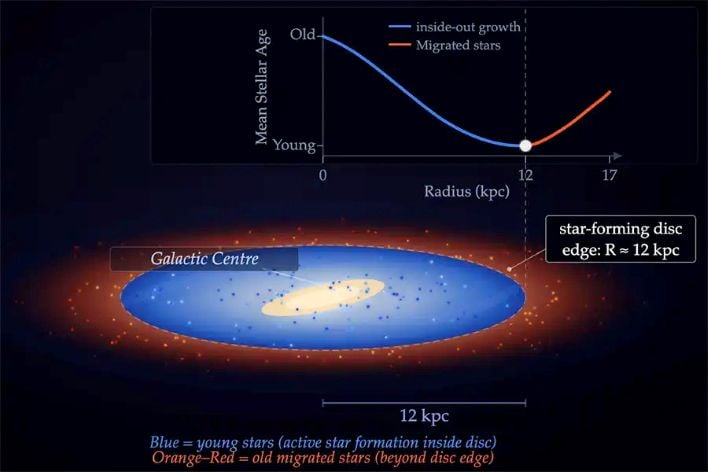
There is still some uncertainty about the physical reason for the cutoff. Gas density, spiral structure, and the Galaxy’s broader gravitational environment may all play a role, but the study’s main claim is sturdier than any single theory: the pattern of ages itself is hard to fake. It appears in simulations too, which strengthens the case that the U-shaped profile is a real signature of the Milky Way’s star-forming boundary.
The discovery could also provide a missing piece for understanding the evolution of the Local Group (galaxy clusters that includes the Milky Way and Andromeda). By establishing a precise boundary, astronomers can more accurately calculate the total mass of our galaxy. Current estimates place the Milky Way at approximately 1.5 trillion times the mass of the Sun. Knowing this mass can be useful for predicting the future of the Milky Way, specifically the inevitable collision between it and the Andromeda galaxy, which is currently expected to occur in about 4.5 billion years.





