



Scientists Find DNA And RNA Building Blocks In Asteroid Sample With Big Implications


Rock sample analysis from the asteroids Ryugu and Bennu (collected in 2018) has confirmed that the entire library of the chemical code for DNA and RNA exists in space.
The space-delivery theory for life’s origins has been missing several chapters. While meteorites that crashed into Earth often contained some of these ingredients, scientists could never be certain if the more fragile molecules, such as cytosine and thymine, were original to the rock or absorbed from the mud and bacteria of our own planet. The samples returned by Japan’s Hayabusa2 and NASA’s OSIRIS-REx missions have finally settled the debate. Because these rocks were vacuum-sealed in space and returned directly to clean-room laboratories, the presence of adenine, guanine, cytosine, thymine, and uracil within them proves these compounds exist in space.
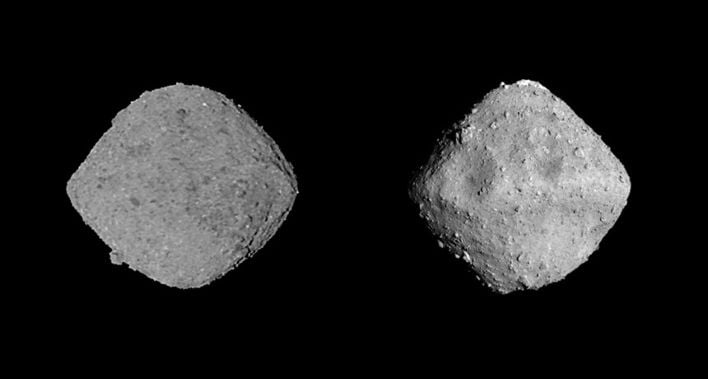
Researchers published their findings in the Nature journal confirming the presence of all five canonical nucleobases, i.e. adenine, guanine, cytosine, thymine, and uracil, within the Ryugu samples, which are key to writing the instructions for DNA and RNA. Moreover, the team has noted a fascinating correlation between the abundance of these nucleobases and the presence of ammonia.
On Bennu, the OSIRIS-REx team found an organic molecule soup, including 14 of the 20 amino acids necessary for life, alongside high concentrations of ammonia and minerals that likely formed from the evaporation of ancient, icy brines. Perhaps these asteroids were once part of parent bodies that hosted liquid water.
What makes the Ryugu and Bennu samples particularly special is their isotopic signature. The analysis suggests these building blocks didn't necessarily form in the warmth near the Sun. Instead, they appear to have originated in the frigid, radiation-drenched environments of the outer solar system or even the interstellar molecular cloud that predated our Sun. Could this mean that life's starter kit is a universal phenomenon, synthesized in the cold vacuum, and preserved in asteroids like Ryugu?
As these carbon-rich rocks pelted early Earth billions of years ago, they didn't just bring destruction; they sometimes brought a precise chemical payload. Based on what Ryugu and Bennu are telling us, life as we know it might not have started with a single smoking gun after all.
Main photo credit: Surface of Ryugu by Mascot/DLR/JAXA





