



Samsung's Rumored Gaia AI PC Chip May Actually Be an AI Accelerator


To be clear, nobody on our staff actually reads Korean. Still, after comparing multiple AI translations of the original reports and looking closely at the terminology being used we don't get the impression of a new SoC, because rather than describing Gaia as a complete processor or system-on-chip, the Korean reports consistently characterize it as an "AI accelerator" optimized for generative AI workloads.
Specifically, the articles describe Gaia as complementing an existing processor rather than replacing it, even going as far as to explicitly mention it as being separate from the CPU (described in contrast as the "brain" of a PC), which obviously doesn't sound much like a Snapdragon X competitor. What it sounds like is more of a dedicated NPU that could be deployed alongside conventional x86 or Arm processors in desktop workstations, servers, or even high-end AI PCs.
Other details from the reporting match up with this interpretation, too; Samsung is said to have begun performance validation with OEMs with specific callouts for HP and Lenovo. That would be relatively straightforward for a PCIe AI accelerator or similar expansion device, but bringing up an entirely new Arm PC platform would involve substantially more hardware and software enablement work than simply validating an add-in card or module.
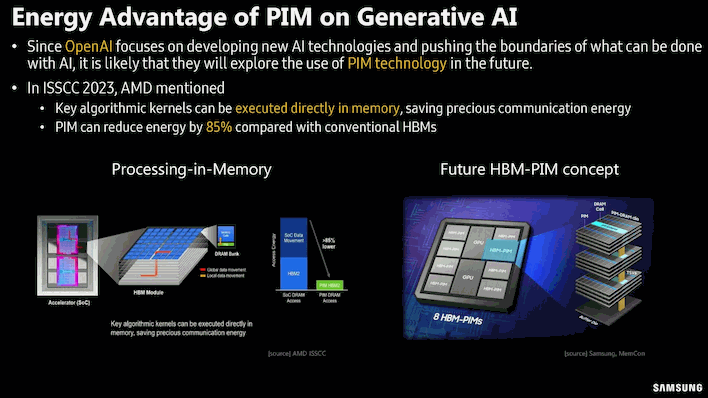
Another interesting detail from the Korean reports is that Samsung is apparently planning to pair Gaia with its Processing-In-Memory (PIM) research in the future. PIM integrates compute capabilities directly into memory chips to reduce data movement during AI workloads. This is sort of a half-step toward a fully neuromorphic processor like Intel's Loihi, and could have enormous gains in terms of performance and power efficiency versus using conventional GPUs for AI work.
Now, none of this means Gaia can't be or become part of a larger processor. Samsung could very well be developing a standalone AI accelerator today and then later integrate the underlying NPU architecture into an Exynos-derived AI PC SoC or another heterogeneous processor. The same AI IP could also scale across workstations, servers, robotics, and edge AI products.
It's also entirely possible that something got lost in translation, or that the Korean reports simply don't describe the full scope of the project. Really, until Samsung says something publicly every interpretation remains speculative.





