



AMD's Zen 6 Desktop Chips May Trade Integrated Graphics For AI NPUs


AMD is reportedly planning a major change for its next-generation Zen 6 desktop processors, trading basic video diagnostics for localized AI processing. Based on the leak, the upcoming 2027 CPU lineup, codenamed "Olympic Ridge," will introduce an integrated NPU directly onto the processor's I/O die, making it the first mainstream desktop lineup from AMD to feature dedicated hardware for machine learning workloads without being classified as an APU. To accommodate this new silicon, AMD could completely eliminate the iGPU altogether. Huh?
Olympic Ridge:
— Gotou_3rd (@Gotou_kai3) June 15, 2026
+ integrated NPU
+ CUDIMM support
- integrated GPU
Still no integrated USB4 controller support.
Currently, Ryzen AM5 desktop chips include a modest RDNA-based iGPU containing two Compute Units, which lacks the power for serious gaming but serves as a crucial tool for office deployments and system troubleshooting. By removing this, AMD frees up critical physical area and thermal headroom to incorporate a robust NPU, which can help Olympic Ridge meet Microsoft’s escalating hardware requirements for local AI acceleration and Copilot+ compliance natively on the desktop.
The rumored change (which leaker Moore's Law Is Dead previously touched on, along with Zen 6 topping 6.5GHz) likewise means that PC builders and enthusiasts will once again be entirely dependent on discrete graphics cards, forcing troubleshooting workflows for hardware failures or black screens back onto secondary GPUs.
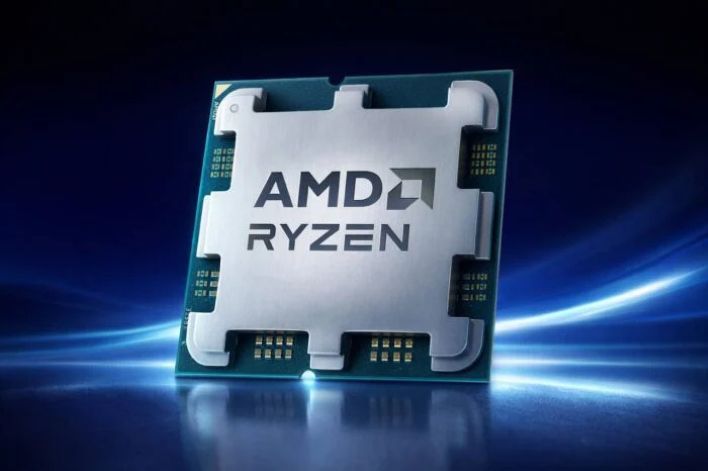
Aside from the (supposed) iGPU removal, the Olympic Ridge family will feature upgrades to its core computing blocks. The lineup is expected to transition to a newer fabrication node, utilizing TSMC’s 2nm N2P process that promises substantial improvements in instructions per clock (IPC), overall thermal efficiency, and power scaling.
The architecture will also debut a brand-new Core Complex Die (CCD) design capable of housing up to 12 individual Zen 6 cores paired with 48MB of shared L3 cache. This setup permits a flexible matrix of core configurations across the product stack, enabling AMD to scale processors from entry-level six-core variants up to high-end dual-CCD models boasting 24 cores and 48 threads. Additionally, 3D V-Cache variants remain in the picture to target high frame-rate gaming markets.
While maintaining socket continuity on the existing AM5 platform, the updated ecosystem will introduce enhanced memory controllers optimized for Clocked Unbuffered Dual Inline Memory Modules (CUDIMM), pushing stable memory speeds higher through tighter clock synchronization directly on the memory stick. The platform will also integrate full AMD EXPO 1.2 feature profiles, Ultra Low Latency kits, expanded high-speed I/O lanes, and native Wi-Fi 7 wireless network support. However, early leaks indicate that an integrated USB4 controller still will not be included.
AMD's Olympic Ridge lineup is expected to go up against Intel's Nova Lake-S platform, both set to launch in early 2027.





