



NVIDIA Unveils Nemotron 3 Open Models To Power High-Efficiency Agentic AI


Nemotron 3 is not NVIDIA's first entry into foundation models, nor its first Nemotron release. Earlier models focused on reasoning-enhanced language tasks and enterprise deployment, often built on top of existing open architectures such as Meta's Llama family of open models. A Nemotron model was what powered NVIDIA's ACE demo in the game Mecha Break. With Nemotron 3, NVIDIA is doubling down on openness, publishing not only the model weights but also its training recipes as well as and large portions of the pre-training and post-training datasets used to build them.
The Nano variant that's currently available targets efficiency and flexibility; the model files are distributed in standard open formats compatible with popular frameworks. NVIDIA is also providing optional low-precision and hardware-optimized variants for those deploying at scale, but the base models themselves are not locked into proprietary formats. This makes Nemotron 3 Nano usable across a wide range of research and production environments, from local experimentation to enterprise inference pipelines.
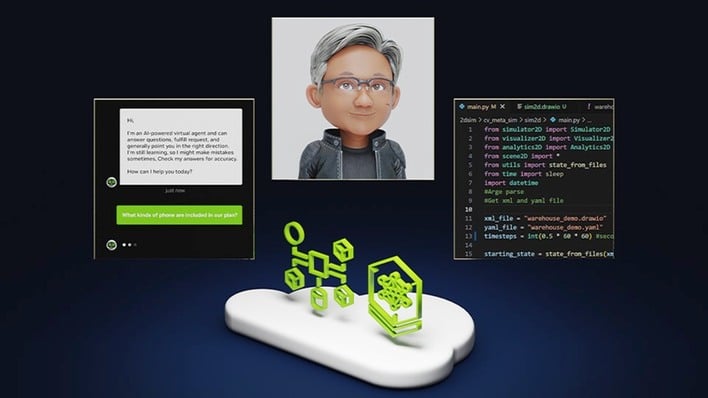
NVIDIA has framed Nemotron 3 around agentic AI use cases, emphasizing reasoning, tool use, and integration into larger workflows rather than simple chat applications; the idea is that, rather than time-wasting chatbots, agentic AI can perform repetitive work so that humans can focus on tasks that require human judgment. The company's stated goal is to enable developers and organizations to build autonomous or semi-autonomous AI systems that can plan, execute tasks, and interact with external tools to accomplish preset goals.
The most ambitious part of the roadmap is Nemotron 3 Ultra, a model NVIDIA says will reach roughly 500 billion parameters when it launches early next year. At that size, it would rank among the largest openly available language models, a notable contrast to the closed, API-only systems that dominate the top end of the market. Running such a model will require serious infrastructure, but its release would represent a rare case of near-frontier-scale capacity being made freely accessible.
Taken together, Nemotron 3 reflects NVIDIA's broader AI strategy: advancing the practical science of large-scale machine learning while anchoring that progress to an open ecosystem of models, data, and tooling. The models are free, but the bet is clear; as agentic AI grows more capable and more common, demand for the hardware and software stacks underneath it will grow with it—and NVIDIA will be there to supply it.





