



NVIDIA DLSS 5 Backlash: Jensen Huang Says ‘AI Slop’ Critics Are Completely Wrong



That's really what he said, too. In a quote to Tom's Hardware, Huang said "first of all, they're completely wrong," referring to gamers criticizing DLSS 5 based on the early preview shown at GTC 2026. "The reason for that is because, as I have explained very carefully, DLSS 5 fuses controllability of the geometry and textures and everything about the game with generative AI," he continued.
Tom's didn't seem to post the full quote in its entirety, but he apparently went on to say that DLSS 5 has significant controls for developers and creators to use when customizing the tech to their liking. He says "it's not post-processing [...] at the frame level, it's generative control at the geometry level," and that developers can choose how they want to use it, giving the examples of a "toon shader" or an area "made of glass."
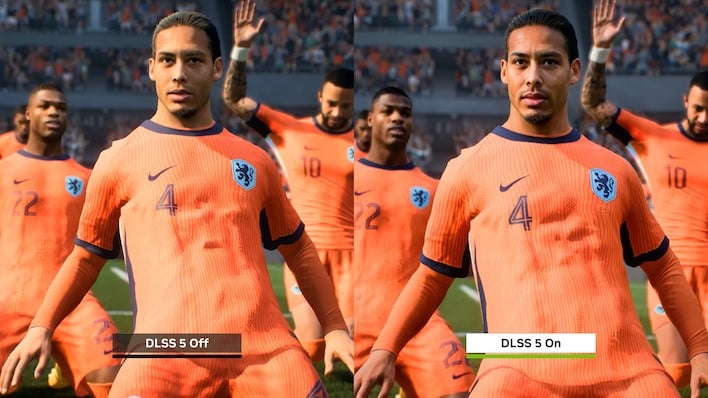
EA SPORTS FC with DLSS 5
Setting aside for a moment the fact that we already have perfectly functional deterministic toon shaders and advanced PBR material pipelines designed to simulate glass, it's easy to see why Jensen was concerned as gamers reduced what was assuredly the result of months of hard work to inflammatory terms like "AI slop". Huang sees DLSS 5 as the first step toward fully neural rendering, where there is no "raster" pass at all and the entire game's visuals are imagined with AI. In that context, when you show someone what you believe is a glimpse of the future and they reject it outright, well, you can understand the indignation.
There are plenty of real criticisms of DLSS 5 as presented. In the demos so far, it inarguably changes the entire vibe of the game, replacing the look and feel of the hand-authored content to something that is arguably more realistic but perhaps less authentic or curated. The demos at GTC also require a whole second 32GB graphics card to handle the neural rendering, but to both points, HotHardware Editor in Chief Dave Altavilla points out that it's early days for the technology.
Indeed, Dave saw the tech first-hand at GTC and called it "very impressive"; you can see our video on that above. Others who saw the tech first-hand, including PC Mag and Digital Foundry, also came away with positive impressions. Yet even the latter outlet, well-known for historically being generally favorable to NVIDIA, has pulled back from its initial enthusiasm with a new video posted today that addresses some criticisms of its first-look preview coverage as well as some criticisms of DLSS 5 itself. The new video is definitely worth a watch if you're interested, as DF goes over DLSS 5 in a very thorough and even-handed way.
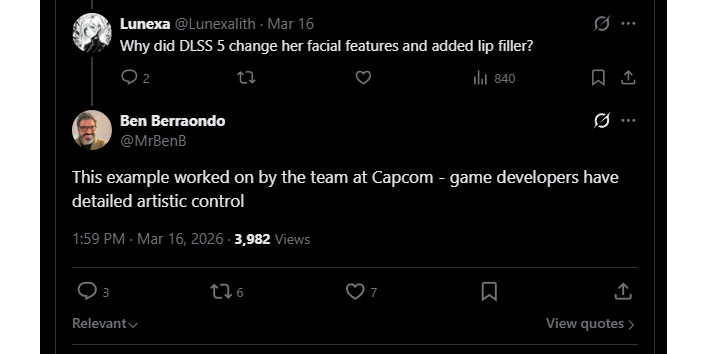
NVIDIA's Ben Berraondo, Senior Director of Global PR for GeForce, challenged folks on Xwitter, which is a daunting task for which we salute him. Ben says that the specific Resident Evil 9 Requiem example that's got so many people referring to DLSS 5 as an "Instagram filter" that "yassifies" characters, was actually worked on by the team at Capcom. He echoes Huang's sentiments above that developers have complete control over the technology. However, Insider Gaming reports that its sources inside Capcom and Ubisoft were not aware of the DLSS 5 demo at all until it was shown to the public.
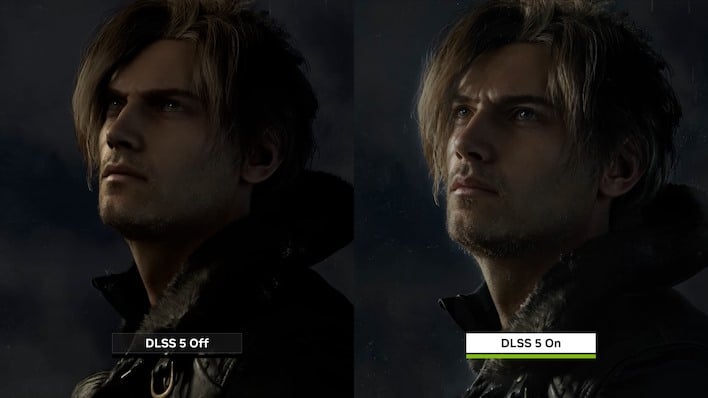
As much as people want to collapse the truth into one narrative or the other, the simple truth is that these two stories aren't contradictory; it's very likely that a small subset of people at Capcom worked on the DLSS 5 demo, and it's also very likely that plenty of lower-level employees in the studios were not notified of the upcoming tech, especially considering how protective NVIDIA can be of its embargos and pre-release products.
Another potential criticism of DLSS 5 that has been raised is that the nomenclature is arguably a bit strange. So far, DLSS as a technology has largely been about trying to preserve what a game was meant to look like before it was rendered in low resolution. DLSS upscaling and especially frame generation are still controversial in some camps, and so adding this AI re-imagining technology to the DLSS brand was likely to stir up some frustration from folks fed up with AI encroaching on gaming.

It's not clear to us exactly what Jensen means by "generative control at the geometry level" considering that, despite his claim that it's "not post-processing," it explicitly is post-processing done in screen space going by NVIDIA's own statements. In fact, it appears to essentially be a video-to-video model, similar to earlier efforts at producing photorealistic images from gameplay footage. We have no doubt that the technology is highly configurable; it's quite likely that you craft a text prompt to instruct the model what sort of 'look' or 'vibe' you want the scene to have. (Note: this is speculation, not based on anything said by NVIDIA.) These AI models are very demanding, which is probably why the demo required a second GeForce RTX 5090 to run.
To be clear, I haven't seen it in person, and NVIDIA says that this is a very early demo that doesn't represent the final product. A few developers, including JP Kellams from Epic Games and Todd Howard of Bethesda, have come out vocally in support of DLSS 5 as a counterpoint to the avalanche of hatred it provoked from gamers and gaming commentators like Asmongold and Maximillian Dood. If NVIDIA indeed gets DLSS 5 running well on a single GPU, you better believe you'll get some in-depth coverage right here on HotHardware.





