



NASA's Voyager 1 Is About To Reach An Historic Space Exploration Milestone


In 2026, Voyager 1, humanity's farthest reaching Energizer Bunny of a probe, will travel toward an almost comprehensible benchmark: being a full light-day away from Earth. According to NASA's data, the milestone is projected to occur around November 15 next year.
To call the distance vast is an understatement; one light-day translates to approximately 16.1 billion miles (25.9 billion kilometers) from home. To fully grasp this cosmic scale, astronomers typically measure across the universe in light-years, a unit representing 5.88 trillion miles. In contrast, the closest star system, Proxima Centauri, still lies 4.2 light-years away, yet the distance Voyager 1 has covered is an achievement normally confined to the realm of science fiction.
The vast distance traveled also means that communication to and from mission control at NASA's JPL will now be a nearly two-day affair: radio signals, traveling at approximately 186,000 miles per second, take a little over 23 hours each way, leaving engineers to wait nearly an entire day for confirmation of commands sent. Unless someone invents a subspace communicator first, of course.
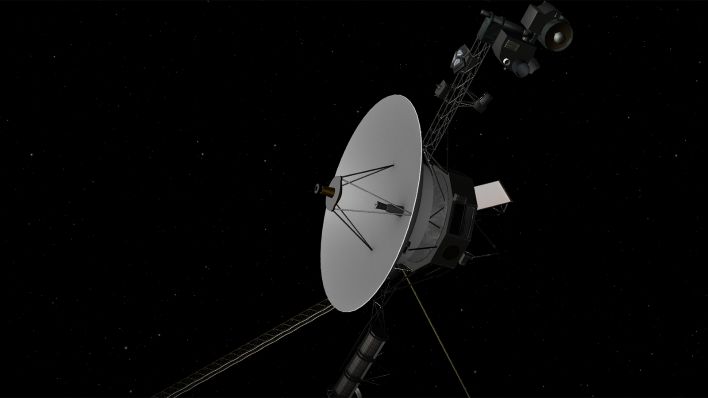
Launched in 1977, the probe’s primary mission was to tour and study the outer planets in the solar system. After which, Voyager 1 was tasked with charting a course into the unknown. In 2012, it officially punched through the heliopause, whereby the magnetic boundary where the sun's influence ends and true interstellar space begins. Most impressively, despite its advanced age and reliance on 1970s technology, Voyager 1 continues to sail towards the light-day goal at about 11 miles per second, adding roughly 3.5 astronomical units to its total separation from Earth every year. Its instrumentation, while requiring frequent (and sometime heart-stopping) software fixes from billions of miles away, still beams back crucial data about the interstellar medium, telling us about the magnetic fields and particle soup found in the cosmic void.
Voyager 1 has an expiration date, though. The craft's three radioisotope thermoelectric generators (RTG) will eventually run dry. For decades, engineers have expertly conserved and rationed this dwindling power source, prioritizing only the most essential science instruments and communications gear. Nonetheless, these RTGs are expected to finally run out of juice entirely sometime in the 2030s (some say sooner).
Voyager 2, while merely 19.3 light-hours from Earth, also continues its flight into the unknown as the second most-distant human-made object.





