



NASA Declares Start Of 2026 Fireball Season As Meteor Activity Intensifies


Heads up sky-gazers, fireball season is upon us! That's according to NASA, which notes that we're now in peak fireball season, a time period that typically runs from February through April. During that time, exceptionally bright meteor sightings can increase by 10-30%, especially around the March equinox. That date has already come and gone, but expect more fireball sightings over the next several weeks.
Curiously enough, astronomers have not yet figured out the precise reason for increased meteor sightings around this time of year, only that is not out of the ordinary.
"Exactly why is not known. Some astronomers think the Earth passes through more large debris at this time of year, causing an uptick in fireball sightings," NASA says. "Another likely reason it may feel like meteor sightings are increasing is that more of us have cameras at the ready — from smartphones to doorbell cameras to dashboard cameras — making it easier than ever to capture and share these fleeting cosmic events when they happen."
Indeed, a recent fireball streaking across the skies over Ohio was recorded on numerous devices, including home security cameras, and sparked a space rock scavenger hunt for meteorite wreckage. And before that, a huge fireball lit up the skies in Europe as fragments of the meteorite fell to Earth and slammed into at least one German home.
That isn't quite as rare as one might think. Last summer, fiery meteorite fragments believed to be older than Earth smashed into a home in Georgia. Analysis of the fragments determined that they could be around 4.56 billion years old, and that the meteorite originated from the main asteroid belt between Mars and Jupiter.
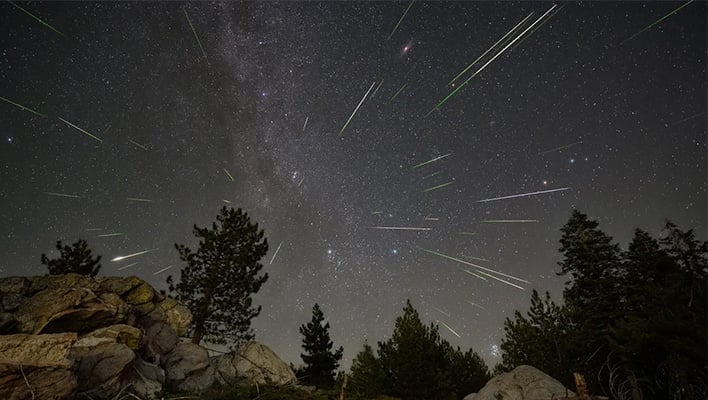
In NASA's blog post declaring that it's fireball season, the space agency answers several burning meteor questions, including how common meteor sightings are. The answer? Quite common, even though they often have a tendency to streak across skies over the ocean or unpopulated areas with no witnesses.
You'll also see NASA use various, similar-sounding terms. What exactly is the difference between a meteor, meteorite, and a meteoroid? Here's you cheat sheet...
- A meteoroid is a small rock or particle traveling through space, usually a piece of a comet or asteroid.
- A meteor refers to the streak of light in the sky that appears when a meteoroid enters Earth’s atmosphere and disintegrates.
- A meteor shower occurs when meteoroids that have a common origin (like debris from a comet) and very similar orbits enter the atmosphere.
- A meteorite is a piece of space rock that survives the trip through the atmosphere and lands on the ground.
- A fireball – the brightest of them all – is a meteor that shines brighter than the planet Venus. They are caused by particles that are larger than the ones producing “normal” meteors. Sometimes fireballs are called bolides – the words are interchangeable and refer to the same phenomenon.
NASA also notes that not only can you see meteors, especially during fireball season, but you can hear them as well. That's because they travel through Earth's atmosphere at hypersonic speeds, the effect of which is a loud, explosive sound, otherwise known as a sonic boom, that can be heard on the ground.
Now that fireball season is here, it's perhaps your best chance to see a meteorite, either again for the first time.




