



Micron Defends AI Pivot And Rejects Claim It Abandoned Consumer Market


As far as Micron is concerned, the prevailing narrative about its recent strategy shift to focus more heavily on AI customers gets one *ahem* Crucial detail wrong. Actually more than one, though the biggest misconception from Micron's vantage point is that it's abandoning the consumer market in favor of AI, when in reality it's simply serving consumers in a different way.
Micron's VP of Marketing, Mobile, and Client Business Unit, Christopher Moore, had a lengthy chat with WCCFTech about the memory market the moves the company is making to navigate an evolving landscape.
"I would never want to tell someone what to think or that they're wrong, but our viewpoint is that we are trying to help consumers around the world. We're just doing it through different channels. We still have a very sizable business in the client and mobile markets," Moore said.
He followed that up by noting Micron is obviously servicing its data center clientele as well, a point not in need of emphasis after the company ended its consumer-facing Crucial brand after nearly three decades. Nevertheless, his point is that the total addressable market (TAM) for the data center is growing, and Micron wants to be sure it services those customers too.
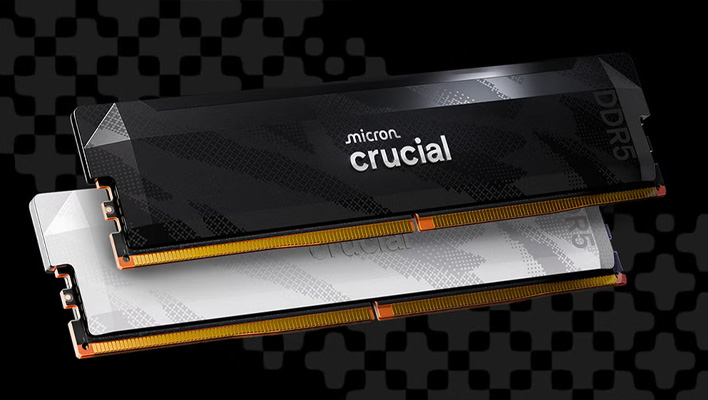
How do you square Moore's comments with the decision to bid farewell to its Crucial brand after 29 years? That's a little more difficult to answer. When announcing that Crucial was being retired, Micron noted that there's been an AI-driven surge in demand for memory and storage in the data center, and it came to the "difficult decision" to end its Crucial consumer business "to improve supply and support for our larger, strategic customers in faster-growing segments."
As far as breakup letters go, that one bucked the traditional, 'It's not you, it's me' in favor of, 'I'm smitten with someone else'. But according to Moore, it's not a breakup at all.
"What's happening now is that all these data center build outs are going on, and the TAM of the enterprise or data center business is growing what used to be 30, 35%, and then to 40%, and now to 50% and 60% of the overall market is requiring more bits than what used to happen," Moore says.
Moore points out that the entire industry is short, and that this isn't simply a Micron issue, but an industry-wide one where its peers and competitors are also scrambling to service the data center market. Even so, he says it's "really important for people to understand we are still serving the consumer market."
The way Micron is servicing the consumer segment is changing, though. Moore talks about being a major supplier of memory chips to OEMs for systems targeted at consumers, which is a fair point. Even more interesting, however, are his comments on increasing capacity.
Moore explains that it's not as simply as plugging in new machines on the assembly line and calling it a day. When there are different machines for one piece of silicon, stopping them to run another one slows down output.
"We're saying, you know, I know you used to wanna go from 12 gigabyte to 16 gigabyte, or 16 gigabyte to 24 gigabyte. Those changes actually drop our output. So we're working with them to try and get our demand as steady as possible so that we can get our supply as steady as possible and maximize the output," Moore says.
He also talked about breaking new grown in Idaho at Micron's ID1 facility, which is expected to come online in the middle of 2027, and the timeline to be up and running for "meaningful output." We're not sure anything he said will change anyone's opinion, but the full interview is definitely worth a read.




