



LG Display Study Claims 480Hz OLED Monitors Boost FPS Accuracy By 38%


Are you having trouble picking off your esports opponents and routinely finding yourself dragging down your squad? Blame your monitor. Or more accurately, blame your monitor's refresh rate. If anyone gives you grief about it, point them to a new LG Display study that purportedly found a massive 38% jump in accuracy when gaming on an OLED monitor with a 480Hz refresh, compared to gaming at 60Hz.
Also, don't shoot the messenger. We read through LG Display's press release and our first thought is that this needs further investigation with a larger sample size. For the study, LG Display conducted a blind test with 31 gamers playing an unspecified first-person shooter (FPS) on an OLED monitor running at 60Hz, 240Hz, 360Hz, and 480Hz refresh rates in random order.
Testing measured a series of quantitative indicators, including the number of successful hits (hit score) and event interval time, which is how much time elapsed from target appearance to elimination. The study also tracked qualitative indicators such as smoothness, ease of tracking, and overall preference by each participant.
"Higher OLED refresh rates significantly reduce input lag—the delay between input signals and on-screen response—as well as motion blur. In the experiment, input lag was reduced by more than 10 milliseconds at 480Hz compared to 60Hz. This reduction enabled gamers to determine the positions of fast-moving enemies more accurately," LG states.
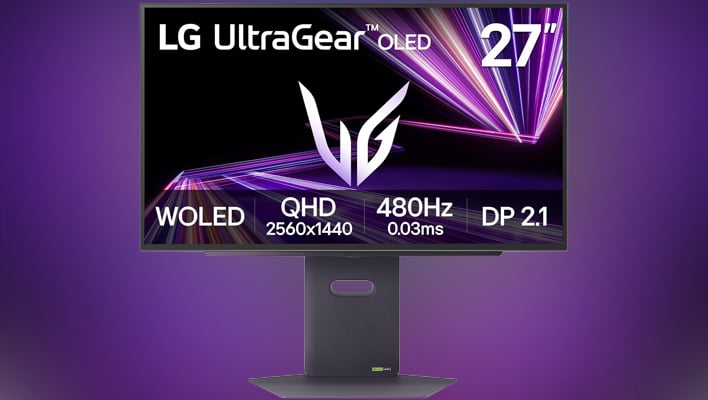
According to LG Display, gamers achieved a significantly higher win rate even at 240Hz compared to 60Hz, though for anyone wondering about the point of diminishing returns, bumping up to 480Hz saw an increase in win rate by an additional 10%.
"This indicates that gaming performance continues to scale consistently as the refresh rate increases.
Qualitative satisfaction also improved as the refresh rate rose. Participants reported that higher levels resulted in smoother visuals and made it easier to track moving targets, which directly contributed to a stronger overall preference," LG Display says.
LG Display said it plans to build on the study's findings by focusing on more high-refresh-rate OLED monitors aimed at gamers. It also hinted that we could see more dual-mode OLED monitors that let gamers choose to jack up the refresh rate when dropping below the display's native resolution.
This is not the first study of its kind. There are others like it, such as the one NVIDIA recently highlighted indicating that higher refresh rates improved performance, while shifts from higher to lower refresh rates degraded it. That said, the study also found that "performance did not significantly differ between 144Hz and 360Hz conditions," so there's definitely nuance to the discussion, especially as the industry prepares to push past these boundaries with recent high-refresh-rate milestones hitting 720Hz.




