



JWST Sees Mysterious Exoplanet With Atmosphere That Breaks All Predictions


The planet, designated PSR J2322-2650b, has simply been described by astronomers to look like a lemon. This bizarre world, located 750 light years from us, is not only physically misshapen, it also possesses a chemical composition that appears as equally as bizarre as its exterior shape. When the first data sets reached Earth, the reaction from the research team was one of pure bewilderment. Peter Gao of the Carnegie Earth and Planets Laboratory summarized the collective sentiment perfectly: "What the heck is this?"
As it is, PSR J2322-2650b orbits really close to a pulsar, as in a mere one million miles away. Therefore it's no wonder that the planet is being literally stretched due to the pulsar’s immense pull on the Jupiter-mass world. How the planet itself came to be might remain a mystery, but at some point it lost its roundness, bulging into the ellipsoid shape reminiscent of a football or a lemon. To give you a better idea of how tight 2650b's orbit against its pulsar is: a single year on this planet lasts only 7.8 hours, meaning it completes three full orbits in the time it takes an average person to finish a workday.
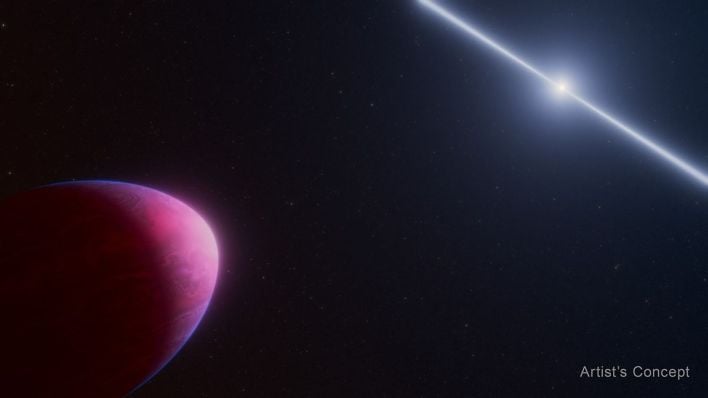
Generally, most gas giants are dominated by hydrogen and helium with traces of water and methane. However, JWST found something entirely different: 2650b’s atmosphere is thick with helium and molecular carbon, specifically C2 and C3. There is no detectable water, no methane, and no carbon dioxide. In fact, the research team had never seen an atmosphere like this in their exoplanetary research.
"Instead of finding the normal molecules we expect... we saw molecular carbon," explained Michael Zhang, the study's lead researcher from the University of Chicago. He noted that the planet’s composition seems to rule out every known formation mechanism in the book.
The presence of so much carbon leads to some truly exotic weather, too. The researchers believe that soot clouds likely drift through the dark skies, and deeper within the planet’s interior, intense pressures may cause this carbon to crystallize, where the sky might quite literally rain diamonds, or perhaps even have a core made of solid gemstone.
One theory to explain the existence of the planet opines that it is part of a "black widow" system, in which a pulsar slowly evaporates its companion star with high-energy radiation. This "lemon" might actually be the skeletal remains of a former star, stripped down to its core until only a planetary-mass husk remains.





