



Razer Blade 16 Laptop Honed With Panther Lake, Faster RAM And Up To RTX 5090


Intel's hardware partners are starting to unleash new laptop configurations built around the Core Ultra Series 3, otherwise known as Panther Lake, that was introduced at CES earlier this year. One of those partners is Razer with a refresh of its Blade 16 gaming laptop. The latest iteration of what Razer's thinnest laptop features a Core Ultra 9 386H chip built on Intel's 18A process, along with a handful of key upgrades over last year's model.
The Core Ultra 9 386H sits just one tier below Intel's flagship Core Ultra X9 388H within its Panther Lake lineup. It wields 16 cores, including four performance cores clocked at 2.1GHz to 4.9GHz, and eight efficiency cores clocked at 1.6GHz to 3.7GHz. Other key specs include 18MB of L3 cache and a dedicated NPU capable of up to 50 TOPS for AI workloads.
Razer's upgrade to Panther Lake represents a 33% jump in cores compared to last year's model, which featured up to an AMD Ryzen AI 9 HX 370 processor based on Zen 5. It can still be paired with up to 64GB of memory, though the 2026 model built around Panther Lake uses faster LPDDR5X-9600 memory chips, compared to LPDDR5X-8000 on the the 2025 iteration.
The latest Blade 16 refresh also bumps up the GPU options. Whereas last year's Blade 16 could be configured with a GeForce RTX 5070 (115W TGP) or GeForce RTX 5060, this year's model offers GeForce RTX 5090 (165W TGP) and GeForce RTX 5080 (165W) GPU options.
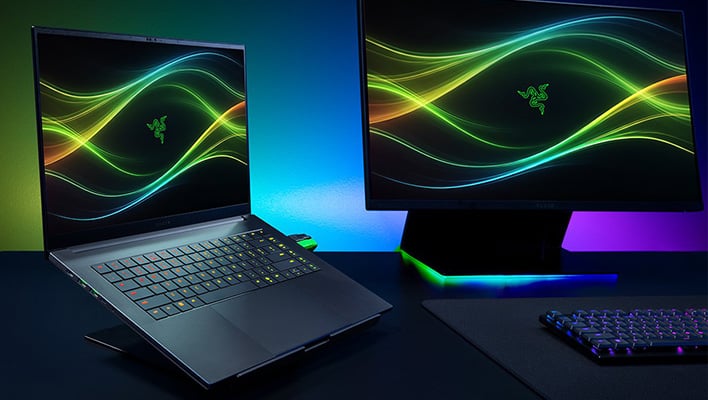
This year's model also touts a brighter QHD+ (2560x1600) OLED display. In SDR mode, it can hit up to 500 nits (up from 400 nits), and for HDR content, it can manage and eye-searing 1,100 nits (up from 500 nits). It also bears VESA's DisplayHDR TrueBlack 1000 badge and is Calman verified with custom-calibrated color profiles, Razer says.
Better connectivity is on tap too, with Razer kitting the latest Blade 16 laptop with Thunderbolt 5 and Thunderbolt 4 ports (to go along with three USB 3.2 Gen 2 Type-A ports, a full-size HDMI 2.1 output, and a USH-II SD card reader), as well as Wi-Fi 7 and Bluetooth 6.0 for wireless duties.
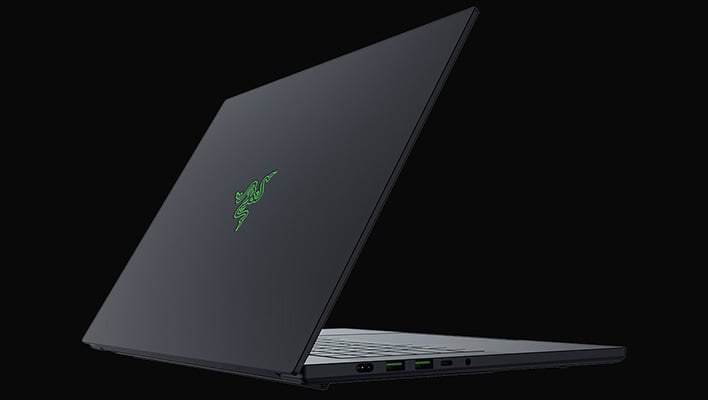
Finally, Razer is claiming much better battery life to the tune of up to 15 hours of video playback and up to 13 hours of "modern office" (versus 10 hours and 8 hours, respectively), and an upgraded 6-speaker audio system with 7.1.4 surround sound powered by THX.
It's fairly robust for a yearly refresh. The catch, of course, is pricing. Razer's laptops command a premium and the retooled Blade 16 is no exception—pricing starts at $3,499, which gets you 32GB of RAM, a 1TB SSD, and a GeForce RTX 5080. Opting for the GeForce RTX 5090 adds $1,000 to the tally while also doubling the storage to 2TB.




