



Intel Razor Lake-AX Leak Suggests Return of Integrated Memory on Package


Intel's first and only products to use on-package memory were the Core Ultra 200V processors, code-named Lunar Lake. After the launch of those chips, then-CEO Gelsinger said that Lunar Lake was a "one-off" and that on-package memory created "too many dependencies," by which he was referring to the practical and logistic concerns of selling chips and memory together to OEMs. Gelsinger actually went so far as to call it "a financial mistake".
Given that, it seems almost absurd to suggest that Intel could bring back on-package memory, but things are different now. There's a new CEO, Intel Foundry is firing on all cylinders, and reportedly, Intel is doing on-package memory quite differently from last time.

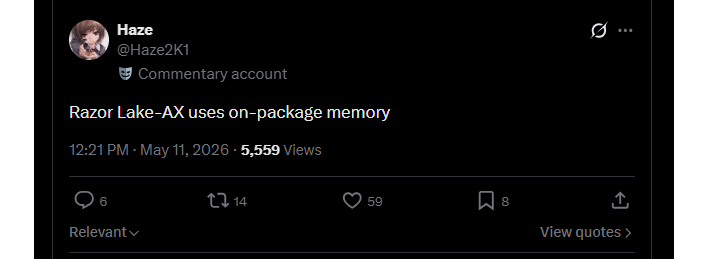
The well-informed Golden Pig Upgrade Pack posted last week on Weibo that Intel would bring back on-package memory, and while he didn't name Razor Lake-AX as Haze did, he did reveal something else: OEMs will reportedly be responsible for getting the RAM and also for attaching it to the chips. That's what he means by "SMT"; it's not simultaneous multi-threading (that's not coming back to consumer anytime soon), but rather "Surface Mount Technology", in this case referring to mounting the BGA LPDDR5X packages onto the CPU package.
It's unlikely that any of the OEMs would handle this themselves; it's not the same as attaching the same chips to a laptop motherboard. This kind of advanced packaging integration needs to be handled by a shop dedicated to the process, known as Outsourced Semiconductor Assembly And Test, or OSAT. These are companies like ASE Group (and its SPIL subsidiary), Amkor Technology, China's JCET, PowerTech, and many others.
On-package memory offers considerable benefits in terms of both performance and power efficiency, to say nothing of what it rewards in terms of physical space efficiency. Apple uses on-package memory for all of its M-series SoCs, and Intel may feel that it can't really compete with those parts without doing the same. Passing the memory costs on to the OEMs is a bold strategy, but in the current "RAMmageddon" era, it might be the only move that makes sense financially.





