


Intel Arc G3 Play Leak Teases Cheaper Handhelds With A Big Catch


Videocardz exclusively reports that the Arc G3 Play will once again be based on Panther Lake silicon, but on that chip's smallest configuration. Strictly speaking, chip like this have been known for a while in their Panther Lake guise, such as the Core 7 335 with four P-cores, four LP E-cores, and four Xe3-cores. However, the Arc G3 Play will apparently use a different, "0+8+0+4" configuration, with no P-cores and no LP E-cores, and instead eight E-cores.

That would be an very odd configuration. Panther Lake has a GPU tile with four Xe3-cores already; that part's not surprising. However, the only way to get a "0+8+0" configuration for CPU cores using the extant Panther Lake compute tiles would be to use the larger 16-core tile and then disable both the P-cores and the LP cores. That's a lot of wasted silicon for what's supposed to be a low-cost part, but it's possible Intel has many reject dies that fit this criteria.
The obvious "catch" mentioned in the headline is that these chips will have a relatively small GPU with just four Xe3-cores. This isn't quite the limitation it might seem, though. Xe3-cores are quite potent; the Arc G3 Extreme with twelve Xe3-cores absolutely stomps all over the Ryzen AI Z2 Extreme with its 16 RDNA 3.5 compute units. In our testing, despite being ostensibly a smaller GPU, the Arc G3 Extreme often delivers 40-50% higher performance than the Ryzen Z2 Extreme.
Some of that is down to process improvements, and those same process improvements won't carry forward to a 4-Xe3 version of the Arc G3, as that GPU tile is made on Intel 3 instead of TSMC's superior N3E process. Still, back when the original CPUs for Socket AM5 (the Ryzen 7000 processors) first debuted, we tested their extremely dinky 2-CU RDNA 2-based graphics and found that you could actually get a pretty enjoyable performance even in lightweight 3D games like Fortnite. So saying, this chip should have a considerably more powerful GPU; while I wouldn't recommend playing, say, Pragmata on one, titles like GTA Online, Apex Legends, and Elden Ring should be no problem for the GPU.
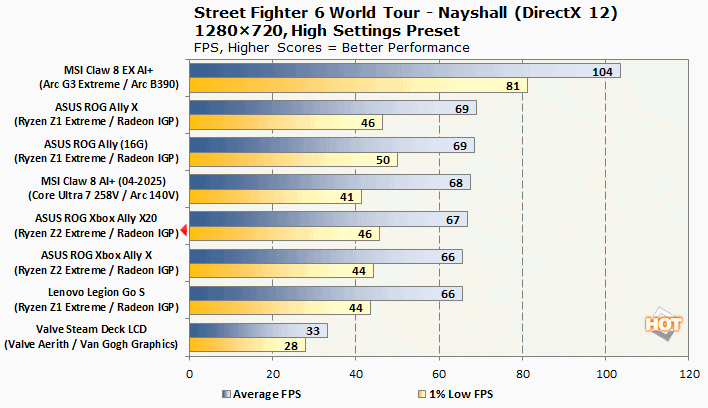
The supposed 8-E-core configuration is arguably a bigger concern as far as game performance. In my review of the ROG XBOX Ally X20, I found several games (out of the 20 I tested) that had CPU performance problems down to awkward scheduling on the 3+5 configuration of the Ryzen AI Z2 Extreme processor. In at least one case (CS2), manually limiting the game to run on the three high-performance cores improved frametimes considerably, but other games, including Baldur's Gate 3, preferred to run on the larger Zen 5C core cluster. Clearly, the validity of using eight lower-performance cores over a smaller number of high-performance cores depends on the game.
Videocardz doesn't say when handhelds with these chips might come around, but does note that it could allow vendors to bring Panther Lake handhelds "below $800." Indeed, while we've been a big fan of both of the Intel-based handhelds we've tested, they've been scarce on the ground and very expensive; the MSI Claw 8 EX AI+ that we tested was over $1700 and has only gone up since—a price point that puts it in reach of much more powerful Strix Halo handhelds. Hopefully we see a new wave of cheap Intel-based portables sooner than later.