



Google Chrome Accused of Secretly Installing 4GB AI Model, Raising Privacy and Legal Concerns


That said, it's surprisingly easy to disable AI features in Chrome, including permanently deleting the weights.bin file. In fact, I did so as soon as I noticed the Gemini button being added to my Chrome window, and right-clicking it to disable it. After that, you need to open up "chrome://flags" in your address bar, and find the "Enables optimization guide on device" flag. Disable it and the folder containing the weights.bin file will automatically be deleted, and it won't come back. The persistence of the file when manually disabled is most likely due to this conflicting browser flag, and Chrome repairing itself, and not malicious intent.
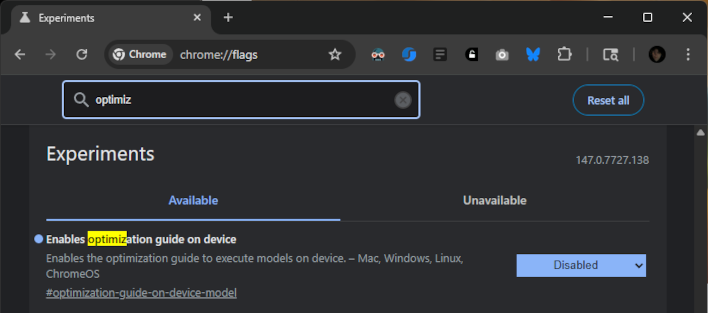
There are still some strange things at play here, as discussed at length by The Privacy Guy. Actually disabling AI features is buried in Chrome's oblique flags menu rather than any obvious settings list, and the persistent nature of the weights.bin file does raise some eyebrows when Chrome users simply never explicitly consented to hosting a 4GB AI model on their devices to begin with. The Privacy Guy correctly identifies that this behavior by default is being done without permission, and even considers it a breach of the GDPR, the ePrivacy Directive, and arguably even the Corporate Sustainability Reporting Directive (CRSD).
The ecological impact of just the silent weights.bin distribution is estimated between six and sixty thousand tons of CO2-equivalent emissions, depending on how many devices receive the Gemini Nano model. Strangely, this model is mostly unused by Chrome's AI Mode features, which connect to Google's cloud. The Privacy Guy also strikes a point against this, since AI Mode is not obviously "cloud-backed" and a reasonable user may assume everything is localized to the device.
It's not a great look for Google. Others, like Microsoft, have also gotten heavy pushback for AI implementation in their products, particularly Copilot in Windows 11. Fortunately for Windows users, Microsoft is dialing back on that, and perhaps Google will follow suit by making Chrome's AI features opt-in rather than an opt-out.




