


AMD Zen 6 Medusa Point APU Drops The Hammer In Geekbench Leak


Originating from HXL, who spotted the result in the Geekbench Browser, the "LENOVO 22ETPF6DTA" sports an "AMD Eng Sample: 100-000001713-32_Y", which is an unknown processor with four cores in one cluster, six cores in another cluster, and a reported frequency of 2 GHz. Despite the 1996 MHz "Maximum Frequency", digging into the JSON reveals that Geekbench actually recorded clock rates between 2812 MHz and 3817 MHz.

If accurate, that would be incredible, because the 3100-point single-threaded score is high enough to put this engineering sample in the same broad performance class as the desktop AMD Ryzen 9 9950X, which is rated at 3069 points on the Geekbench 7 Processor Benchmarks chart. That chip has much more cache and a maximum boost clock of 5.7 GHz; if Medusa is matching (indeed, beating) that score at just 3.8 GHz, that suggests an absurd IPC uplift.
However, there's plenty of reason to believe that the clock measurements aren't accurate; besides the insane performance they imply, there are other faulty clock readings, like the aforementioned "maximum frequency" and a listing of "5188 MT/s" for the memory. That's almost assuredly incorrect for the LPDDR5X RAM that would be paired with this part (although it's possible the test platform is using socketed DDR5 DIMMs, in which case 5200 MT/s is perfectly plausible.)
On systems with incorrect or incomplete ACPI tables, it can cause all kinds of timer weirdness, and this is obviously not a retail system. It's very likely that this engineering sample has busted ACPI and many of the measurements and samples performed by Geekbench are incorrect. However, the work completed by the chip is validated in the course of the benchmark and this benchmark is listed as Valid. That means that the score is real, it's just that the measured clocks aren't.
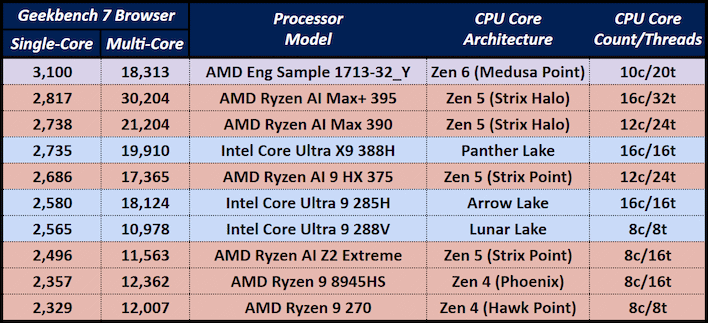
This suggests a huge uplift from AMD's previous-generation "Strix Point" parts. If we compare the single-core scores, Geekbench is presenting a "standard" score of 2496 (ST) / 16045 (MT) for the flagship Ryzen AI 9 HX 375. That's a huge 28% gain in single-threaded performance, and multi-core goes up by 14% despite the fact that our Medusa Point engineering sample has two fewer cores and also seems to be running slow memory versus most Ryzen AI 300 (Strix Point) machines.
This engineering sample may not be representative of the full performance of the final chip; it may be running on a test bench with unlimited power, and it may be using a memory configuration that won't exist in final Medusa Point products. On the other hand, there may be additional tuning to be done in the firmware or even in the metal layers of the processor, depending on when exactly AMD intends to launch the chips. Final Medusa Point silicon could end up significantly slower or markedly faster than this. Hopefully we'll know sooner than later.