



10-Core AMD Zen 6 CPU Crushes Single-Core Test On Geekbench


The new result is the same "Plum-MDS1" processor with the same "AMD Eng Sample: 100-000001713" descriptor, although where that one was "-31_N", this one is "-33_N". That likely represents a newer revision of the chip, platform, or firmware, as the processor itself seems to be identical: ten total CPU cores, and 10MB of L2 cache plus 32MB of L3 cache.
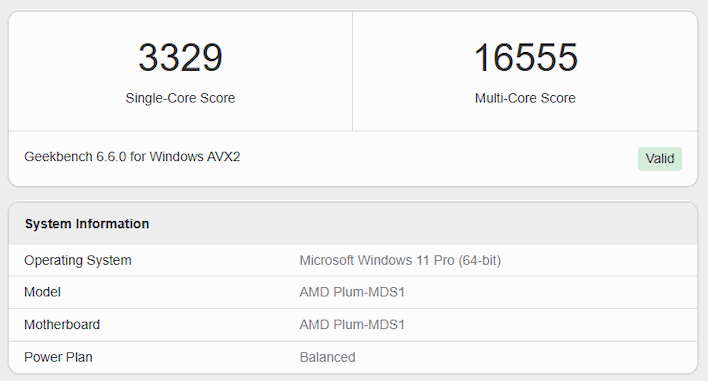
Still, the scores are much higher than that earlier sample. A single-core score of 3329 puts it ahead of every single other x86-architecture laptop CPU we've tested, including power-thirsty desktop-class chips like the Core Ultra 9 290HX Plus. A multi-core score of 16555 doesn't look that impressive on the face of it, but when you consider that it's a 10-core CPU—technically a 4+6-core CPU—it's not bad at all. We also think that the multi-core score may have been limited by power.
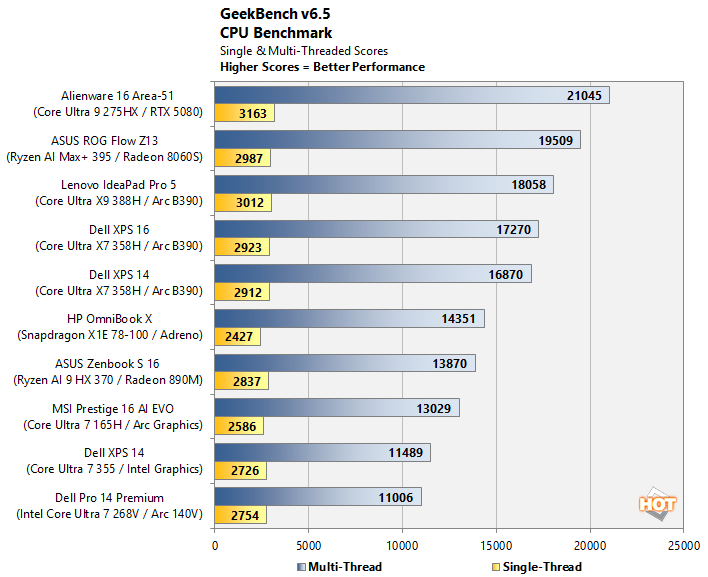
Notably, these results beat the Ryzen AI 9 HX 370, AMD's current laptop flagship (Ryzen AI Max notwithstanding) no matter whether you take Geekbench's curiously low average score, our results when testing a laptop with the chip, or even an overclocked machine. Primate Labs puts down the Ryzen AI 9 HX 370 for an "official" score of 2606 on a single core and 13400 across all cores. That makes the Medusa chip some 28% faster on a single core and 24% faster across all cores versus last-generation. Comparing our own results, we came up with a single-core score of 2837 (-15%) and 13870 (-16%) on the multi-core tests. Looking at a clearly overclocked Framework 13, the Strix Point part put up 2920 (-12%) ST and 15637 (-5.5%) MT.
What's really interesting is that the Medusa Point part delivered these scores while running at a lower average clock rate than either of the other two results. If you look at the JSON data for a Geekbench result, you can see the frequency values captured during the tests. While some commenters have remarked on the high ~5.35 GHz achieved during the testing—around 200 MHz faster than the Ryzen AI 9 HX 370—arguably the more interesting part is that if you average all of the values captured, the Medusa Point part comes out to an average clock rate of just 4.46 GHz. Meanwhile, the average frequency during our Strix Point testing was 4.84 GHz, and the average frequency from the overclocked machine was 5.1 GHz.
That means that the Medusa Point part is actually beating the current-generation chip despite a significant clock rate disadvantage. That could be due to all kinds of factors; it could be influenced by memory performance, or the fact that this is likely a test bed and not a retail laptop. However, it could potentially indicate a significant uplift in instructions per clock (IPC), a measure of how efficient a CPU core is. Combined with a clock rate bump, we could be seeing a major boost in mobile CPU performance when these chips launch, hopefully late this year or early next year.
Shout out to HXL (@9550pro on Xwitter) for the spot!





