



AMD Ryzen AI 9 HX 470 Spotted With 12 Cores At 5.25GHz & 16 RDNA 3.5 GPU Cores


To be clear, what we have are Geekbench results for the AMD Ryzen AI 9 HX 470 and the AMD Ryzen AI 7 450. Just a CPU benchmark for the latter, but the HX 470 gives us both CPU and GPU compute results. All three were spotted by Gray (@Olrak29_ on Xwitter), a familiar name in this little hardware enthusiast community of ours.

The CPU results are exactly as expected. The Ryzen AI 9 HX 470 appears to be the exact same thing as a Ryzen AI 9 HX 370, just with higher clock rates. That means four Zen 5 CPU cores, eight Zen 5C dense CPU cores, and 24MB of L3 cache in total. The differences come in the clocks; the new chip seems top out around 5.25 GHz, which is an extra 150 MHz of boost clock over the last-gen part.
Meanwhile, the Ryzen AI 7 450 comes in with a peak clock rate around 5.15 GHz, likewise a 150-MHz bump from the Ryzen AI 7 350's 5.0 GHz peak boost. This chip appears to be based on "Gorgon Point 2," which is analogous to the extant Kraken Point (or Krackan Point) chips in that it is a smaller die featuring the same technologies as the full Gorgon Point. As such, it has four Zen 5 cores and four Zen 5C cores, as well as a smaller GPU.
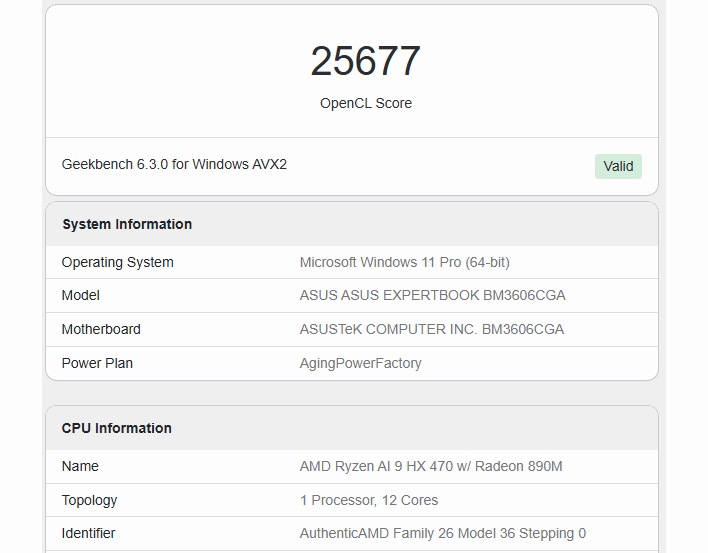
We don't have specific details on the Radeon 860M GPU in the Ryzen AI 7 450, but we do know a bit about the Radeon 890M in the Ryzen AI 9 HX 470. That's because someone ran the OpenCL compute benchmark on the Radeon 890M GPU of the flagship part. The result isn't impressive—it's around half of other Radeon 890M results—although we have to point out that the 64GB of RAM in the ASUS Expertbook used for testing was running at 5572 MT/s, likely with extremely loose timings for stability.
Digging into the test data, the integrated GPU apparently hit a peak boost clock of around 3.1 GHz; not even the desktop Ryzen 7 8700G clocks this high without PBO. If that's accurate, we could see a strong uplift in GPU performance. Pay no mind to the "8 Compute Units" listed in the result; it's measuring Workgroup Processors, not actual compute units. AMD doesn't actually count by "compute units" anymore because the "dual compute unit" or Workgroup Processor is the smallest functional unit of RDNA GPUs. The chip has 8 WGPs, therefore Geekbench sees 8 "cores" or "compute units".
It's hard to get too excited about a modest clock rate bump on refreshed silicon, but Strix Point is still a capable chip. Refreshed models coming clean with all of the firmware and design improvements AMD can shove in from the last 18 months since the original launch of the Ryzen AI 300 series should prove to be even more compelling... if laptop and mini-PC vendors can find memory to buy and pair with the parts. AMD's expected to launch Gorgon Point, the Ryzen AI 400 series, at CES.





