



AMD Overclocks Radeon RX 9060 XT Past 4.7GHz To Shatter GPU Frequency Record


AMD can now officially lay claim to the world's fastest overclocked GPU frequency, a feat it achieved in collaboration with professional overclocker Splave on a modest Radeon RX 9060 XT. Using liquid nitrogen (LN2) to keep temps in check, Splave and AMD's own Bill Alverson pushed the card's GPU clock to 4.769GHz to snatch the crown from NVIDIA's GeForce RTX 4090.
Up until now, the world record for a discrete GPU sat at 4.02GHz (4,020MHz). Incidentally, it was Splave who also set that record back on July 6, 2024, on the GeForce RTX 4090, which at the time was NVIDIA's flagship graphics card for gaming.
AMD's joint effort with Splave was also enough to leap past the fastest frequency on record for any kind of GPU, surpassing the 4.25GHz (4,250MHz) clock speed achieved last May with integrated graphics on an Intel Arrow Lake CPU. Meanwhile, the high mark for an integrated GPU as part of a chipset belongs to an ATI Radeon HD 4290 at 1.353GHz (1,353MHz), set way back in March of 2014, according to ScatterBencher's database.
"Our very own Bill Alverson and well-known overlocker Splave break the GPU frequency OC record in our Markham office using an AMD Radeon RX 9060 XT GPU," AMD states in the description of a short video posted to YouTube, first spotted by Videocardz.
The video is less than 2 minutes long and is short on action, though there are some interesting bits. When asked what he hoped the end result would be, Splave said he would like to see the duo push past 5GHz, though anticipated they would more realistically end up around 4.4GHz to 4.5GHz.
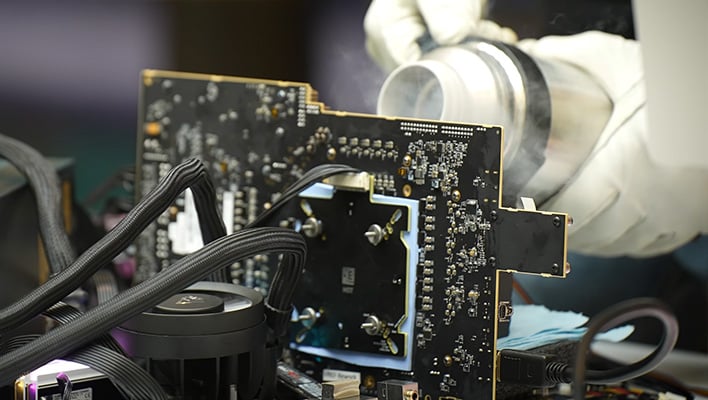
Not only did they exceed expectations, but they beat the previous discrete GPU record by more than 18%. And for reference, AMD's stock blueprint for the Radeon RX 9060 XT, which is based on AMD's RDNA 4 architecture, is 1.7GHz for the base clock, 2.35GHz for the game clock, and 3.13GHz for the boost clock.
Obviously LN2 cooling is not practical for anything outside of chasing benchmark records. Alverson did explain the duo wold start off using air cooling, though it's not revealed how far they were able to push the GPU before switching over to LN2.
Nevertheless, this is an impressive feat. Hats off to AMD and Splave.




