NVIDIA GeForce 7800 GTX 512MB: Upping The Ante


 |
|
;) SC: Chaos Theory |
Based on a heavily modified version of the Unreal Engine, enhanced with a slew of DX9 shaders, lighting and mapping effects, Splinter Cell: Chaos Theory is gorgeous with its very immersive, albeit dark, environment. The game engine has a shader model 3.0 code path that allows the GeForce 6 & 7 Series of cards, and the new X1000 family of cards, to really shine, and a recent patch has implemented a shader model 2.0 path for ATI's X8x0 generation of graphics hardware. For these tests we enabled the SM 3.0 path on all of the cards we tested. However, High Dynamic Range rendering was disabled so that we could test the game with anti-aliasing enabled. We benchmarked the game at resolutions of 1,280 x 1024 and 1,600 x 1,200, both with and without anti-aliasing and anisotropic filtering. |
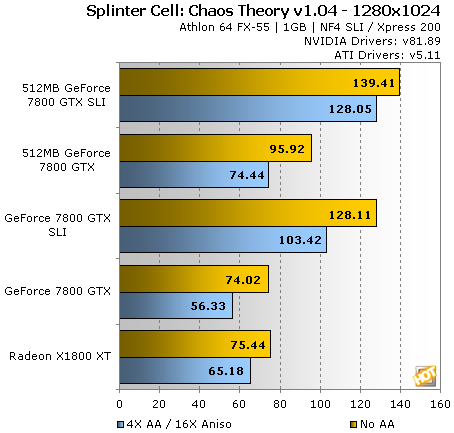

Before today, the Radeon X1800 XT compared favorably to NVIDIA's flagship video card. The Radeon X1800 XT outperforms a 256MB GeForce 7800 GTX by a fair amount at both resolutions and test configurations. But now that NVIDIA has unleashed the GeForce 7800 GTX 512MB, the green team has jumped out to a big lead. The GeForce 7800 GTX 512MB clearly outruns the Radeon X1800 XT at both resolutions, regardless of the test settings. And a pair of 512MB GeForce 7800 GTX cards running in SLI mode literally has a field day in this benchmark. Whereas no single card can break the 60 FPS barrier at 1600x1200 when anti-aliasing and anisotropic filtering are enabled, the GeForce 7800 GTX 512MB SLI rig surpassed the 100 frame per second mark.