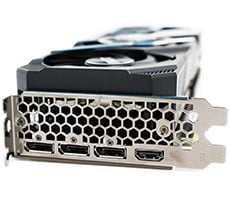
AMD Radeon R9 295X2 Review: Hawaii x 2

Before bringing this article to a close, we'd like to cover a few final data points--namely, power consumption, temperatures, and noise. Throughout all of our benchmarking and testing, we monitored acoustics and tracked how much power our test system was consuming using a power meter. Our goal was to give you an idea of how much power each configuration used while idling and also while under a heavy workload. Please keep in mind that we were testing total system power consumption at the outlet here, not just the power being drawn by the graphics cards alone.
|
|
|


Considering the fact that the Radeon R9 295X2 has a 500 watt TDP, it should come as no surprise that it consumed the most power under load in our tests. Peak power consumptions was slightly higher than the Radeon R9 290X CrossFire configuration and the GeForce GTX 780 SLI setup. Idle power is not much different across the various configurations, though.

In terms of its noise output, however, the Radeon R9 295X2 is significantly quieter than a pair of R9 290X cards running in CrossFire (in Uber mode). Not only that, but the noise produced by the Radeon R9 295X2's larger fans, produces a lower-pitched sound that's less irritating to our ears than the barrel-type fans on other cards. Though the Radeon R9 295X2 is not silent, we wouldn't consider it loud either. We should point out, we measured sound pressure with the card installed in a case (not in an open-air setup), with the meter placed about a foot away from the rear of the system, directly in-line with the outputs on the graphics cards.
We should also mention that temperatures are a non-issue with the Radeon R9 295X2. Coming into this review, we thought the possibility existed for the liquid-cooling loop to become heat saturated, which would cause thermal throttling. But the temperature target on the R9 295X2 is set to only 75'C, and in our testing the GPU temps never exceeded 70'C, even after hours of banging on the card. The surface temp on the radiator only went as high as 45.9'C.