AMD Radeon Pro W7600 And W7500 Review: Value-Driven Pro-Vis Graphics


Power Consumption Testing
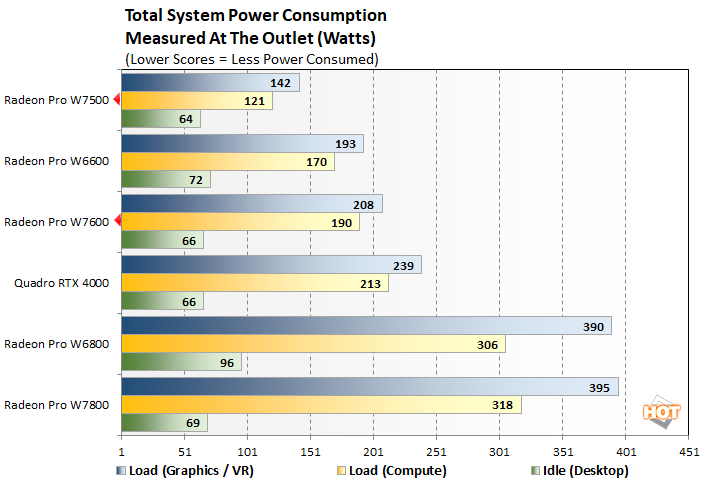
As you can see, the Radeon Pro W7500 consumed the least amount of power, by far. Although its 11Gbps memory holds it back in many benchmarks versus the W6600, the W7500's configuration results in an extremely power friendly board. The Radeon Pro W7600 slots in slightly higher than the Radeon Pro W6600, but that small increase in power comes with a significant increase in performance. The Radeon Pro W7600 And W7500 are clearly more power efficient than previous-gen cards.

Radeon Pro W7600 Hardware Monitoring Metrics
With such low power, both cards run cool and quiet as well. At full tilt, the Radeon Pro W7600 hit temperatures in the high 70° - low 80° range, with a maximum fan speed only a touch higher than 3,000RPM. Throughout all of our testing, these cards were barely audible over the PSU and CPU cooler in our test rig -- thermals and acoustics shouldn't be a problem for anyone.
AMD Radeon Pro W7600 & W7500: The Verdict
AMD has set the SEP for the Radeon Pro W7600 at $599 and for the Radeon Pro W7500 at $429, which is a significantly lower than the $699 introductory pricing on previous-gen cards in this class like the Radeon Pro W6600 or WX 7100.
After digesting the benchmarks, power and pricing, the new Radeon Pro W7600 and W7500 seemed to be positioned very well in the current landscape. The cards have small enough form factors to fit virtually any mainstream workstation and power requirements that won’t necessitate power supply upgrades. Though they’re not bleeding-end in terms of performance relative to higher-end cards, they are ready for next-gen displays and a wide array of applications. Creators or professional workstation users on relatively tight budgets that require the enterprise-grade software and ISV certifications offered by a professional GPU, but don't necessarily require higher-end solutions, should give the new Radeon Pro W7600 and W7500 serious consideration.