



Zen 6 Benchmark Leak Hints At Major IPC Gains For AMD's Next-Gen Chips


When an apparent Medusa Point APU based on AMD's next-generation Zen 6 architecture found its way to Geekbench earlier this week, the big news was the amount of reported L3 cache. Well, whoever is uploading benchmark runs of the mystery chip to Geekbench has done so again, and this time the highlight is on the performance and what looks like a sign of major efficiency and IPC gains for Zen 6.
This wasn't the case with the previous leak. The earlier cameo showed mediocre single-core and multi-core benchmarks results of just 1,210 and 7,323, respectively. Being an early engineering sample (assuming the leak was legit), we can and did shrug those results off as nothing particularly meaningful.
What we found more interesting were the handful of specifications in the listings. It pointed to this particular Medusa Point APU having 10 cores and 20 threads with a 2.4GHz base clock, 10MB of L2 cache, and 32MB of L3 cache.
For reference, the amount of L2 cache is the same as found AMD's 10-core/20-thread Ryzen AI 9 365 Strix Point and Ryzen AI 9 465 Gorgon Point parts, both of which feature four Zen 5 cores and six Zen 5c cores. However, the 32MB of L3 cache on the Medusa Point part is 33.3.% more than both of those APUs. That's a curious and potentially exciting detail if it turns out to be true (it's possible that Geekbench is misreporting the amount of L3 cache).
A closer examination of the log details also revealed that the Medusa Point part was actually running at just over 2GHz for the benchmark run, which could at least partially explain the ho-hum performance. Or does it? A new benchmark run for the what looks like the same chip has emerged and this time, the results are impressive.
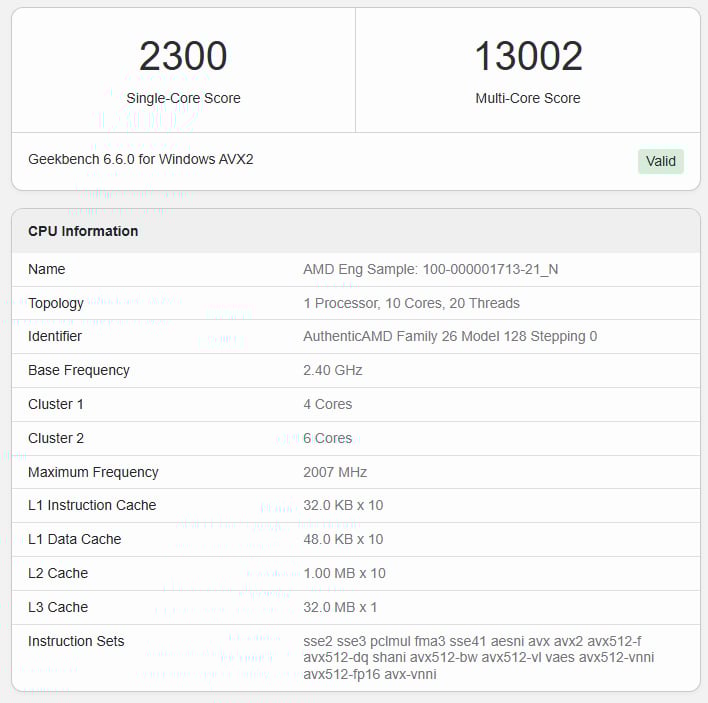
In the latest leak, the Medusa Point APU posted a single-core score of 2,300 and a multi-score score of 13,002. And once again, Geekbench is showing a 2.4GHz base clock, while a closer look at the benchmark log suggests it was actually running around 2GHz to 2.1GHz.
Here's where things get interesting. If we look at Geekbench's list of average CPU scores, we see the Ryzen AI 9 365 getting 2,481 for the single-core test and 12.447 for the multi-core test.
Compared to those Strix Point metrics, the Medusa Point chip's single-score score is 7.3% lower while the multi-score score is 4.5% higher. Bear in mind that the the Ryzen AI 9 365 can boost to 5GHz, so we're seeing a Medusa Point chip with the same number of cores and threads come withing striking distance in the single-core test and surpassing Strix Point in the multi-core test at a fraction of the clock speed.
That's how it appears at a glance, anyway. Being another early leak, the same cautionary caveats apply. We don't know what the true testing conditions were and whether Geekbench is accurately identifying the specs. There is also the question of how Medusa Point chip's Zen 6 and Zen 6c core configuration.
Nevertheless, this latest benchmark leak is a potentially promising early look at Zen 6, and in particular AMD's next-generation mobile APUs.
Nevertheless, this latest benchmark leak is a potentially promising early look at Zen 6, and in particular AMD's next-generation mobile APUs.




