



Venus And Jupiter Will Form A Stunning 'Cosmic Kiss' In The Sky Tonight


If you step outside tonight (June 9) and look toward the western horizon shortly after sunset, you could witness a celestial hookup as Venus and Jupiter appear side-by-side in a rare planetary conjunction.
Due to their striking proximity, the Venus-Jupiter kissing couple will be separated by less than two degrees, a distance so small that you can easily fit your pinky between them at arm's length, or capture both within the field of view of most standard 10x50 binoculars. Venus, tracking higher into the sky as the radiant evening star (so to speak), will easily outshine everything else in the twilight, while the gas giant Jupiter will gleam to its lower left.
While they look like close neighbors from the ground, the encounter is but an optical illusion. Obviously, the planets remain separated by hundreds of millions of miles. In this case, Jupiter is steadily receding toward the solar horizon from Earth's vantage point, while Venus is climbing higher, creating a temporary line-of-sight crossover.
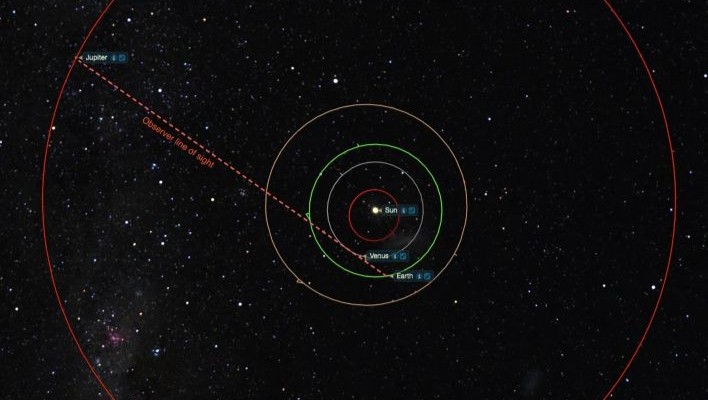
The ideal viewing window opens about 45 minutes to an hour after sunset, once the sky darkens enough for the planets to pop against the twilight glow. Because both planets sit less than 20 degrees above the horizon, they will plunge below the skyline roughly two hours after the sun goes down. So it goes without saying that finding an elevated spot or an open area free of houses, tall trees, and heavy city light pollution will drastically improve your chances of a clear view.
Now, missing tonight’s alignment means quite a wait for the next comparable view. Although Venus and Jupiter cross paths every few years, there are other variables at play. For example, the conjunction in August last year took place in the grueling pre-dawn hours, while the next one in August 2027 will happen too close to the sun’s glare to be visible. Basically, stargazers will not get another easily accessible, prime-time evening view of these two planetary titans meeting like this until November 2028.
Main image credit: NASA/Kelly





