



Valve's VRAM Hack Could Save Millions Of 8GB GPU Owners From Stutters


As Natalie describes it, "it takes exceedingly strong resilience and determination to face the stutters and slowdowns bound to occur when the system starts running low on free VRAM. Carnage erupts inside the kernel driver as every application fights for as much GPU memory as it can hold on to. Any game caught up in this battle for resources will surely not leave unscathed. That is, until now. Because I fixed it."

Before Optimization, much of the AMD GPU's 8GB VRAM is pulled from Cyberpunk 2077 (GameThread) for other applications.
Prior to the fix, Natalie's testing involved opening several applications on Linux before running Cyberpunk 2077 on top of them. While she didn't disclose the exact discrete AMD GPU being used, it's likely the 8GB Radeon RX 9060 XT. Whatever GPU is being used, Cyberpunk is not getting its fair share video memory, with only 6105 MiB of 8176 MiB of VRAM being allocated to the game thread. What's worse is that the system is more prone to the aforementioned stutters and slowdowns, thanks to how Linux handles GPU memory allocation.
After creating and applying kernel patches to optimize this behavior for currently-running games to reduce the slowdowns introduced by swapping resources into and out of system memory to VRAM, Natalie noted a major improvement in both playability and actual VRAM utilization for Cyberpunk 2077. While total VRAM usage on the card decreases, VRAM usage by the actual game increases and background processes are no longer consuming as much video memory. The GTT, which refers to the region of memory accessible by the GPU but located in system RAM, is also much lower.
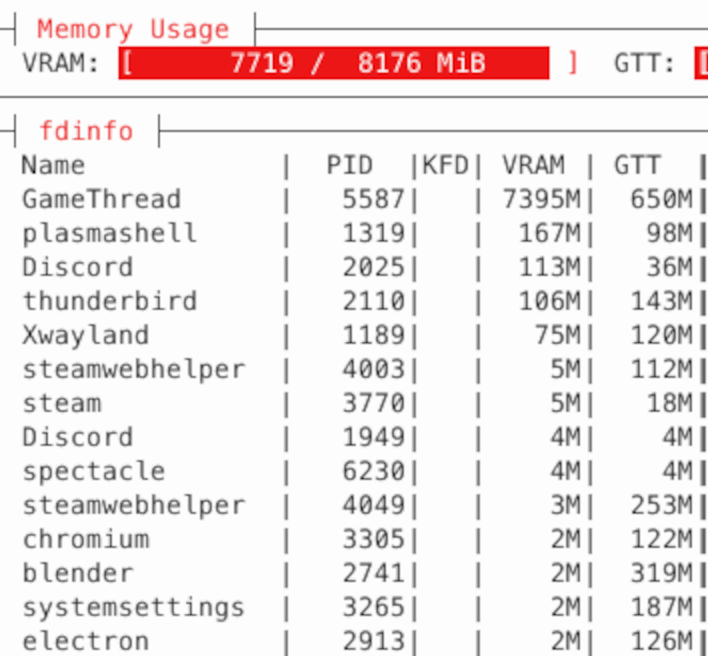
After Optimization, over 1000 MiB of additional VRAM is available for Cyberpunk 2077.
That's a significant amount of additional memory available for the GPU, though without benchmarks, we can't say exactly what kind of FPS improvements it results in. At the very least, frame times should be more consistent, with fewer transactions out to system memory. Unfortunately, NVIDIA's closed-source GPU drivers can't benefit from these patches unless they add support for dmem cgroups, but there is a possibility that Intel GPUs using the Xe kernel driver could benefit.




