



Sun's Sudden Violent Outburst Could Bring Auroras And Radio Blackouts


Right on schedule to welcome the new month, the Sun has turned into a solar firing range of sorts this week, unleashing a sequence of strong solar flares that continue to put power grid managers and satellite operators on alert. Northern light displays can also expected.

Four powerful X-class flares (the highest and most intense category of solar eruption) erupted from the Region 4366 sunspot cluster between February 1 and February 2. The most formidable of the quartet, an X8.1 flare, peaked late Sunday night and now stands as the 19th-strongest solar event ever recorded.
Captured in detail by NASA’s Solar Dynamics Observatory (above), the bright flare flashes signal the release of billions of tons of charged particles into space. Because electromagnetic radiation travels at the speed of light, the initial impact was felt quickly on Earth’s sunlit side, triggering temporary high-frequency radio blackouts that disrupted maritime and aviation communications for up to several hours.
As the week progresses, particularly from the X8.1 eruption, the coronal mass ejection (CME) cloud will be worthy of some attention as it heads towards Earth. NOAA’s Space Weather Prediction Center expects this eruption to collide with Earth’s magnetic field by February 5, likely igniting a G1 to G2 level geomagnetic storm. NBD, then.
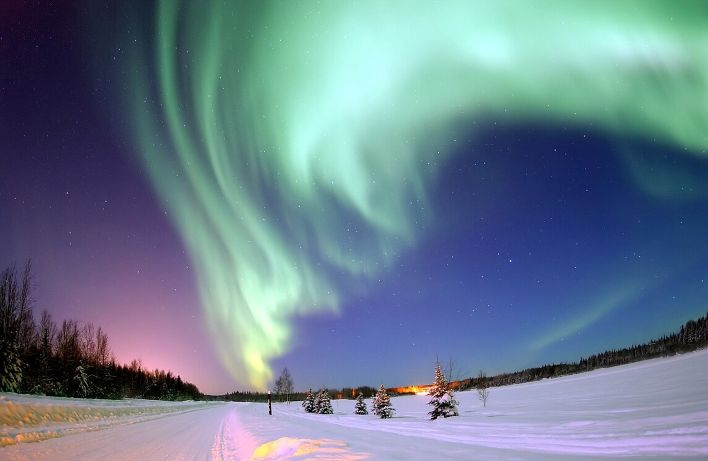
Indeed, these storms can cause minor voltage alarms in high-latitude power grids and interfere with GPS accuracy, but the most visible result could be an expansion of the Aurora Borealis. Residents as far south as Maine, Michigan, and even parts of the northern Midwest may once again catch glimpses of the shimmering green and red curtains of light usually reserved for more Northern regions.
Officially deemed Solar Cycle 25, the cycle was predicted to be relatively mild, but this sudden surge of big flares and sunspot numbers from Region 4366 this early in the year could mean there's more turbulent solar activity to come. Moreover, this bit of news further solidifies the fact that we're currently in the thick of the solar maximum, the most active phase of the sun's 11-year cycle. During this period, the sun's magnetic poles flip, leading to an increase in sunspots and violent eruptions.





