



SPhotonix Touts 5D Glass Storage To Preserve Data For Billions Of Years


SPhotonix is the latest big name in 5D glass storage technology, and it's proving to be quite ambitious in its goal to bring the technology to market, estimating "another three or four years of R&D" to get it there.
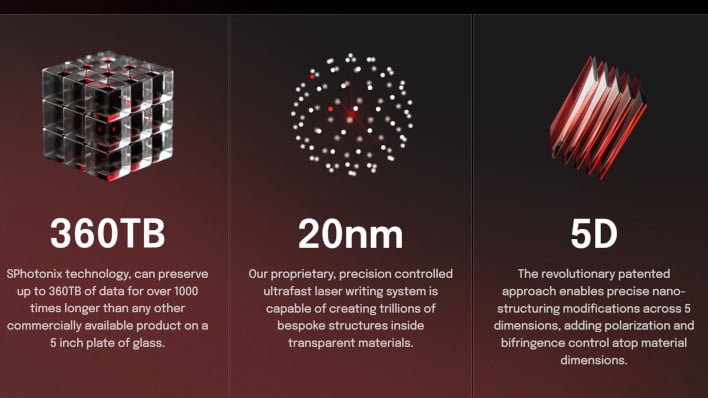
5D glass storage, for the uninitiated, refers to a technique where high-density, high-durability silica glass is used with a combination of laser technology to form 3D pixels (or voxels) from which five dimensions of data encoding become possible. Reportedly, SPhotonix can currently produce 5-inch silica glass platters that can store up to 360 terabytes of data and last up to 13.8 billion years. But like other 5D storage tech we've reported on, there is a key downside: read and write speeds, which would firmly limit this storage to being used for archival purposes.
At time of writing, SPhotonix only reports a current write time of 4 megabytes (32 megabits) per second and a read time of 30 megabits per second, placing throughput in a class long-outperformed by traditional tape and HDD storage. With R&D time, though, SPhotonix believes that it can increase those speeds to 500 megabits (62.5 megabytes) per second, which would compete with traditional tape backups but still be slower than the fastest SATA SSDs.
So, it's not exactly perfect, but in theory this kind of tech could do a lot to help the scene of data centers and archival storage in general, especially as AI demand begins stripping traditional storage and memory from shelves at an unprecedented rate. Speaking to The Register, SPhotonix co-founder Ilya Kazansky (son of co-founder Peter Kazansky) laid out SPhotonix's future plans.
"We believe this is the only way that the industry is going to be able to scale the data storage capacity given the growing demand," Kazansky said. "We are not aiming to become a manufacturing company. We are a technology licensing company. We love the model of Arm Holdings. And to a certain extent, we love the model of NVIDIA. So we are developing the enablement technology, and then we're going to be forming some form of consortium, some form of a group of companies that will help us bring this technology to market."
With initial estimated costs of the read device being $6,000 and the write device being a whopping $30,000, it's clear that the Kazanskys aren't targeting the consumer market anytime soon. However, if their planned consortium does pan out as they hope, and the speed advancements necessary to compete with modern archival storage do manifest in the coming years of R&D, we could see a substantial shift in the data center and enterprise.
Image Credit: SPhotonix




