



Scientists Measure Power And Speed Of A Black Hole And It's Intense


The research, published in the Nature journal, focuses on a stellar-mass black hole located within Cygnus X-1, some 7,200 light years away. As with black holes as we know them, when matter spirals inward, not all of it is swallowed; a significant portion is blasted outward in two opposing jets. Using a combination of X-ray data and radio observations, the team, led by Steve Prabu, determined that these jets are moving at half the speed of light, or roughly 355 million mph. More significantly, they calculated the kinetic power of the jets to be equivalent to the energy output of hundreds of millions of Suns, a scale of force that is difficult to reconcile with the black hole’s relatively small size.
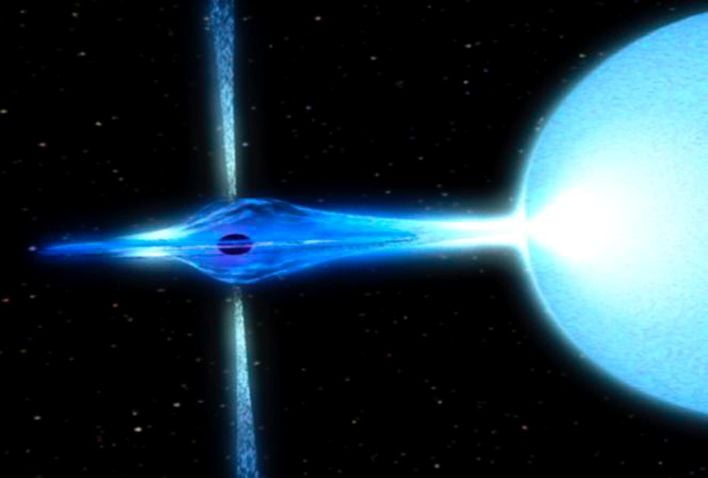
This discovery could likewise provide a vital missing piece for cosmological models. Until now, simulations of the universe’s evolution often struggled to explain why large galaxies stopped growing at a certain point. By providing a hard number for jet power, this study confirms that black holes can act as the ultimate governors of galactic evolution, suggesting that the history of every large galaxy is a delicate balance between the gravity pulling matter in and the explosive, jet-driven energy pushing it back out.
Cygnus X-1 was first discovered in 1964 and is one of the strongest X-ray sources in the sky. Recent estimates place the black hole within X-1 at 21.2 times the mass of the Sun.





