



Scientists Confirm First Direct Radio Signal Detected From Alien World


Centered on the young gas giant Beta Pictoris b roughly 64 light-years away, this latest discovery opens a fresh perspective into the magnetic field and internal dynamics of worlds orbiting distant stars. Astronomers have previously searched the skies for the faint radio crackle of extrasolar planets, hoping to measure their invisible magnetospheres. While previous attempts returned ambiguous signals or blended emission from host stars, a team led by Kevin Ortiz Ceballos and Edo Berger succeeded with the help South Africa’s highly sensitive MeerKAT radio telescope array. By mapping the origin of the signals across multiple observations in 2025 and 2026, the team were able to pinpoint the emissions to Beta Pictoris b, ruling out both its parent star and neighboring planet c.
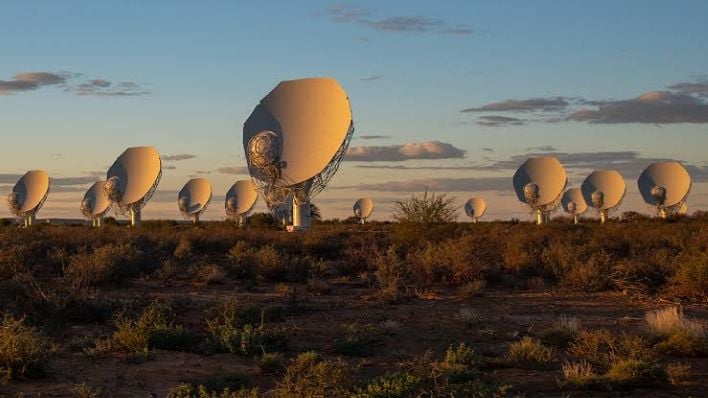
The MeerKAT signal appeared as a continuous radio glow punctuated by sharp, intense bursts that brightened and faded rapidly. A major giveaway was the strong circular polarization of these waves, otherwise known as electron cyclotron maser instability, which occurs when energetic electrons spiral down magnetic field lines, producing strong beams of radio waves that function as giant space lighthouses. On Earth and Jupiter, similar interactions are what drive planetary auroras.
In the case of Beta Pictoris b, the radio bursts peaked near 3.5GHz (or the upper limit of MeerKAT’s instruments) allowing researchers to establish a lower limit for the planet’s magnetic field strength at a staggering 1,250 gauss. For reference, Earth’s surface magnetic field averages roughly half a gauss, while Jupiter’s strongest fields reach about 14 gauss, making Beta Pictoris b a true magnetic monster.
This magnetic characteristic is fueled by the planet’s extreme physical properties it seems. Weighing roughly eight to 12 times the mass of Jupiter, the young super-Jupiter rotates at breakneck speed, completing a full rotation in just eight to nine hours. During one observing window, MeerKAT captured recurring radio bursts spaced about eight hours apart, pointing to a rotationally modulated aurora driven by rapid planetary spin. This rapid rotation generates powerful internal dynamos and drives electrical currents between the planet's magnetosphere and upper atmosphere.
So on second thought, someone might want to call the President: we might have found Magneto's home base.





