



Sapphire Wants AMD To Get Out Of The Way And Let It Go Nuts With GPU Designs


You may not realize it, but we've been here doing our thing at HotHardware since 1999; we remember the good (and bad) old days of the PC enthusiast scene. There was a time when graphics cards were a wild market. You could find Quantum3D Obsidian Voodoo cards with double the RAM and an extra TMU compared to the competition. As late as the GeForce256, you could find cards with hot-clocked RAM and binned GPUs that were 20% faster than another company's model. Even in the DirectX 11 era, it wasn't uncommon to find Radeon HD 5000 series cards with wacky outputs (like DMS-59 or 6x Mini-DisplayPort)--I even owned a pair of GeForce GTX 580 cards with 3GB of RAM onboard.
All of that has gone by the wayside for modern graphics cards. Now, the GPU makers like NVIDIA, AMD, and Intel strictly define what a given SKU (like "Radeon RX 9070 XT") can actually be for their board partners. It must hit these clock rates, it must use this memory, it must run under these temperatures, it must draw this much power, and so on. There's very little wiggle room for board vendors to differentiate their products, which is exactly why Sapphire's Ed Crisler went on a rant on the topic in an interview with Hardware Unboxed:
"I gotta be careful with what I'm about to say here or I'm going to get in trouble. Sometimes, I really wish the chipmakers would get out of the way and just let us partners make our cards. Give us the chip, give us the RAM, tell us what we HAVE to provide to make it work with the board and then let us make the cards. Let us have our fun, let us go nuts, let there be real differentiation. Sometimes it feels like this market becomes too -- too much the same."
— Ed Crisler, Sapphire Technology, speaking to HardwareUnboxed
Crisler didn't elaborate on exactly what he wanted, but he did go on to talk about how there is ultimately little variation between board partners and even within a partner's models of a specific SKU. Add-in board (AIB) partners are allowed to make small clock rate tweaks, but for the most part they're left to secondary characteristics to differentiate their products, like noise and aesthetics. Controversial? No, it's been conventional wisdom for some time that there's little need to spend more on a factory OC GPU—but it's perhaps surprising to hear from a Sapphire representative, being a company that makes most of its razor-thin margins on the higher-end models of its products.
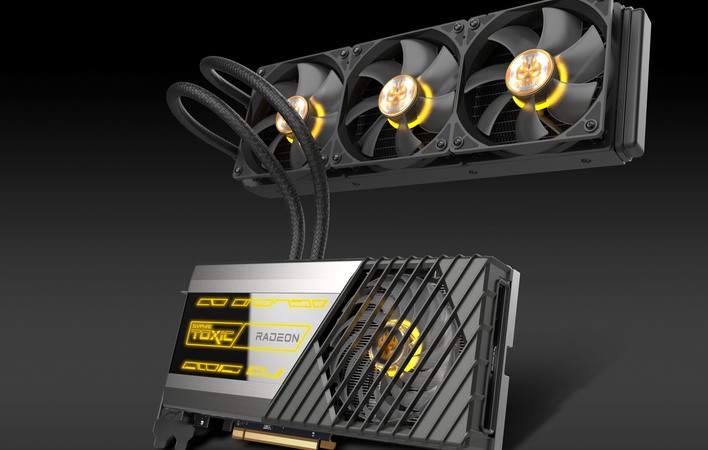
On that topic, Crisler also spoke to a common query he gets: "When is Sapphire going to release another TOXIC card?" For those unfamiliar, "TOXIC" represents Sapphire's halo-tier product, offering something truly exceptional that you simply won't find on other GPUs. Well, that brand reputation is exactly why Sapphire hasn't offered a TOXIC model in a few years, with the last model being the Radeon RX 6950 XT Toxic that sported a scorching 2730 MHz factory overclock, a solid bump over the 2310 MHz of the reference model.
In the GPU vendors' defense, part of the problem may ultimately be that there simply isn't much a board partner could really do to create a product that differs meaningfully from its competition. GPU silicon is pushed close to its limits right from the foundry, thanks to more aggressive binning and qualification from GPU makers. It's rare to find a GPU that will do much more than a couple hundred MHz over its specified clock rate thanks to lack of voltage controls and tight power limits.
Still, like Crisler, we do pine for the old days of picking a GPU based on whether it came with 7.5ns or 6ns memory chips, or the quality of the RAMDAC. It would be nice if we could still find modern GPUs with a proper VGA output, or alternatively, cards with six display connections or doubled-up VRAM without paying the prosumer premium. Alas, that's not the world we currently live in.





