



Samsung's New Display Tech Can Toggle Glasses-Free 3D on 2D Screens


As Samsung says, it's a breakthrough for end users "that could eventually enable them to choose between high-resolution 2D for everyday tasks and immersive, multi-view 3D for video" and "provide both the clarity of 2D and depth of 3D simultaneously."
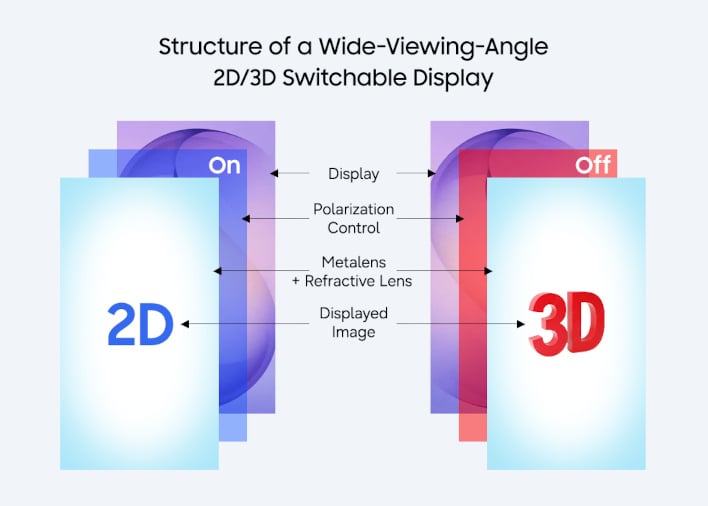
The benefits of a metalens-enabled design don't stop at a dynamic 2D/3D, either. One notable limitation of Samsung's current-gen glasses-free Odyssey 3D monitors (and other contemporaries, like the Abxylute 3D handheld) is an adherence to IPS panels. While IPS panels are admittedly a lot better than TN and VA panels in terms of color accuracy, viewing angles and gamut coverage, they are limited when compared to VA and OLED's deeper contrast or TN and OLED's superb motion clarity. Meanwhile, metalens-enabled 3D technology has already been validated for use with OLED panels, which could have huge implications for next-gen 3D displays across smartphones, tablets, and commercial systems.
This advancement is not limited to just monitors or TVs, but is scalable enough to work with smartphones and other handheld devices. Samsung and POSTECH's work, while most obviously applicable to Samsung's own 3D monitors, is also targeted at Samsung's much wider display market.




