



Samsung's 5-Layer Penta Tandem QD-OLED Tech Doubles Lifespan And Boosts Brightness


Samsung Display is touting its new QD-OLED Penta Tandem technology as a major advancement in premium displays, claiming that its proprietary five-layer structure brings with it numerous benefits compared to its four-layer QD-OLED, not the least of which is double the lifespan. It also purportedly improves luminous efficiency by 1.3 times to achieve "industry-leading brightness" levels.
According to Samsung Display, TVs built around its Penta Tandem tech will be able to crank the brightness all the way up to 4,500 nits, while monitors will be able to hit 1,300 nits. If true, it would take away a key advantage of many mini LED models (though not all of them), which typically have a brightness advantage compared to OLED.
"When the number of organic material layers increases, luminous efficiency improves, enabling higher brightness at the same power level or maintaining the same brightness with lower power consumption. It is similar to five people carrying a load that was previously carried by four, allowing either greater endurance or the ability to lift something heavier," Samsung Display explains.
The shift to tandem OLED, which entails stacking layers, has been taking place for some time now. Samsung Display's Penta Tandem technology isn't new and is already found on some OLED TVs and monitors launched last year as well as earlier this year (presumably including a couple of MSI's monitors announced at CES) , but the company is pitching the completion of its trademark registration for the term as a formal launch
Samsung Display also wants to make clear that there is more the technology than simply stacking layers.
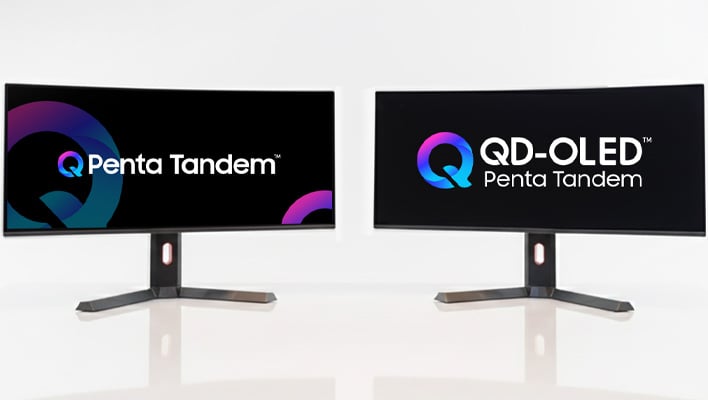
"Multi-layer organic light-emitting structure is not simply about adding more layers. It requires deep expertise in selecting materials and optimizing their thickness and combinations," said Brad Jung, Vice President and Head of the Large Display Marketing Team at Samsung Display.
"Penta Tandem, built on nearly five years of QD-OLED mass production experience since 2021, represents the ultimate choice for customers looking to demonstrate the premium value of QD-OLED," Jung adds.
The other benefit, according to Samsung Display, is being able to achieve VESA's DisplayHDR True Black 500 certification. In order to do so, a display must be able to maintain a black level of 0.0005 nits or lower while reaching a peak luminance of 500 nits at the same time. The claims the only 31.5-inch UHD monitor on the market to achieve the certification is one of its own, built around a Penta Tandem panel.
Now that Penta Tandem is a trademarked term, it will be interesting to see how other players in the display space market their own stacked solutions. Notably, LG last year touted a hybrid tandem OLED technology as being the final step to achieving its "dream OLED."




