



Porsche Patents A Ferocious Tri-Turbo Engine With 18 Cylinders For Future Supercars


In an industry rapidly accelerating toward an all-electric future, Porsche has just reminded us that the age of the internal combustion engine is far from over. How so? A newly-uncovered patent filing has revealed that engineers at Zuffenhausen have developed the design for a radical space-optimized W-arrangement engine featuring 18 cylinders and space for three turbochargers.
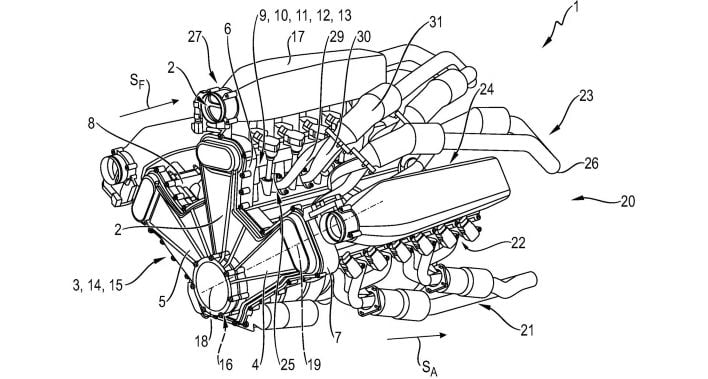
For decades, the W configuration has been synonymous with the Volkswagen Group, infamously used in Bentley's W12 Bentayga and Flying Spur, as well as Bugatti's iconic W16 Veyron. However, these legendary motors are technically formed by two narrow V-banks joined together, often described as a double-V. Porsche’s new patent (filed with the World Intellectual Property Organization) throws out this convention in favor of a "truer" W layout.
The design consists of three separate cylinder banks, each containing six cylinders, all sharing a common crankshaft. If you need a mental image, picture three inline-six engines cleverly fused at the base angled 60° apart. One of the benefits of this arrangement is compact packaging; the W18 is roughly the length of a conventional straight-six. Furthermore, the design is modular, meaning Porsche could theoretically adapt it to create smaller W9 or W15 variants.
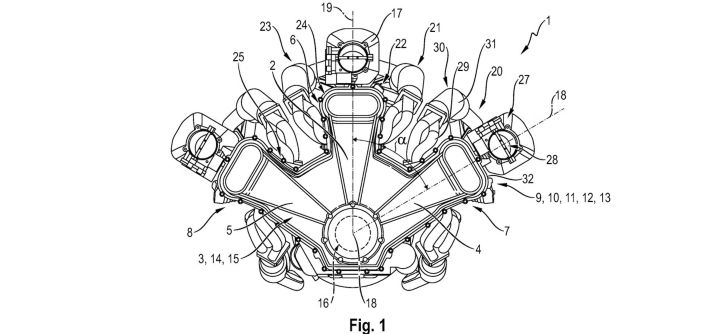
The patent's real party piece lies not just in the cylinder count, but in its thermodynamic efficiency. Porsche claims the W-layout is optimized to minimize airflow friction and reduce thermal interference. The intake runners sit above each cylinder bank, allowing air to be drawn in almost a straight line, while the hot exhaust is routed out between and beneath the cylinder banks. This separation keeps the incoming air cooler and denser, which translates directly to greater power potential. Add to this the capability of fitting a turbocharger for each of the three banks, and the resulting tri-turbo W18 could achieve unprecedented power output for its physical size.
That said, Porsche's patent is a paradox. The company has been one of the most aggressive luxury manufacturers in shifting toward electrification, with all-electric and hybrid models dominating its upcoming product pipeline. While patent filings are often meant to protect IPs and don't guarantee a production model, the sheer audacity of an 18-cylinder Porsche will spark speculation. Could this be the heart of a future limited-run hypercar, a successor to the 918 or another hyper Bugatti perhaps? Or is it merely an engineering research project designed to ensure that when a niche demand for unadulterated, fossil-fueled power remains, Porsche has the answer?





