


NVIDIA Doubles DLSS 5 Speed And Slashes VRAM Use For RTX Spark Launch


IF you haven't read our previous coverage, it goes down like this: DLSS 5 is what NVIDIA calls "3D-guided neural rendering." It's fully regenerating the game image with AI in real-time as you play, and it's using the 3D render created by the game engine as the "guidance" for the generative engine. In so doing, it can produce starkly realistic visuals, filling in lighting and texture details that are simply not present in the original scene.
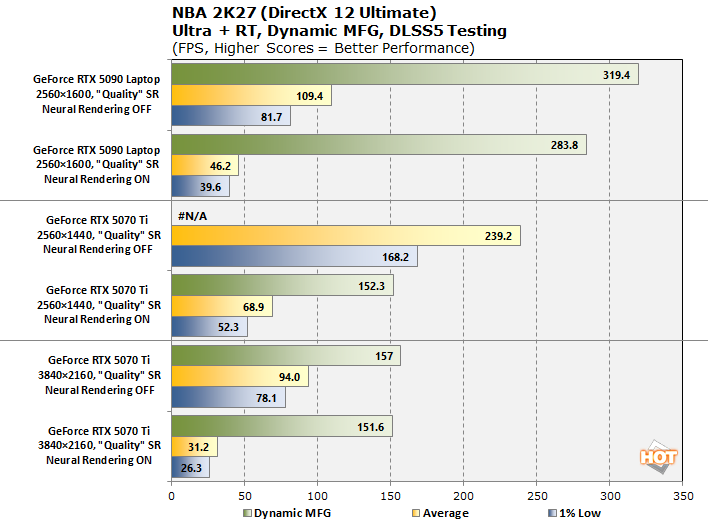
As you can imagine, freshly generating a new frame for every single game frame is enormously taxing. In my tests with NBA 2K27, I found that enabling Neural Rendering whacked my performance down from a mostly capped 240 FPS all the way to 69 FPS. That's a perfectly playable frame rate, but it sure obviates the purpose of my 240 Hz monitor. In 4K it was even worse; the frame rate went from 94 FPS to 31 FPS, cut by more than 2/3rd.
With that in mind, the news that NVIDIA has doubled the performance is very exciting. More than that, the firm says that it has cut video memory usage by about 20% at 4K. While I didn't observe excessive video RAM usage in my DLSS 5 testing, I was using a 16GB graphics card; people on 12GB or especially 8GB cards are more likely to benefit from this upgrade.

November 8th is the launch day for DLSS 5 in Hogwarts Legacy, and you can believe we'll be taking a look at that on both desktop GPUs and the RTX Spark, as the open-world wizard game is one of my all-time favorites. This was one of the games originally showcased when DLSS 5 was first announced, so this integration has been a long time coming.
Besides Hogwarts, DLSS 5 is also coming to online action RPG Where Winds Meet. This free-to-play title has already implemented quite a bit of NVIDIA technology, though its meme-worthy AI-powered NPC conversations are powered by in-house tech, not by NVIDIA ACE. DLSS 5 is coming to the game in "late November".

There are a couple of previews on the NVIDIA site of DLSS 5's effects in both games. I have to say, the early preview of DLSS 5 in Hogwarts Legacy did not look good in my opinion. However, the final release version may actually have swung a little too far in the other direction. I'm eager to see it for myself in a few weeks.
Besides the upgrades to DLSS 5 itself, there's also the news that DLSS 5 is coming to RTX Remix, NVIDIA's framework for upgrading classic PC games with ray-traced visuals. Among the titles being showcased are Fallout 4 and Mirror's Edge (pictured top), both of which see fairly drastic transformations with DLSS 5 engaged.

And, beyond DLSS 5, NVIDIA has also prepared a new "Performance Mode" for DLSS Frame Generation. Almost assuredly aimed to help with the impact of Frame Generation (which can be bandwidth-heavy) on the rather bandwidth-constrained RTX Spark platform, NVIDIA says that the new model is up to 35% faster. The RTX 50-series style of frame generation uses two AI models, one of which exists to serve the role of the optical flow accelerator from the RTX 40 series, and apparently, it was that model that has been improved, with "a lighter and faster" algorithm.
While NVIDIA may not be doing much (at least, outwardly) to get graphics hardware into the hands of gamers, it's undeniable that the firm still has gaming in mind. These software updates are proof that the company is still thinking about improving the experience of PC gaming. As the company says, "stay tuned" for more information on the way, including how well DLSS 5 works on RTX Spark as well as how good it looks in Hogwarts Legacy, and potentially, Where Winds Meet, if there's interest. Let us know in the comments below!