



NVIDIA DGX Station For Windows Puts Trillion-Parameter Blackwell AI Supercomputing On The Desktop


That's a bigger deal than it might sound. Until now, training and fine-tuning large AI models meant spinning up Linux-based infrastructure in a data center. Most companies don't operate that way. They typically run Windows-based machines.
The DGX Station is NVIDIA's answer to that gap. It's also worth noting that this isn't the first time NVIDIA has tried to inch data center-grade silicon closer to the desktop. At CES 2026, we spent hands-on time with Dell's Pro Max GB300, essentially Dell's take on the same GB300 Grace Blackwell Ultra Desktop Superchip concept, though that system ran NVIDIA's Linux-based DGX OS. The new DGX Station for Windows is the next step, finally bringing that hardware into a Windows environment.
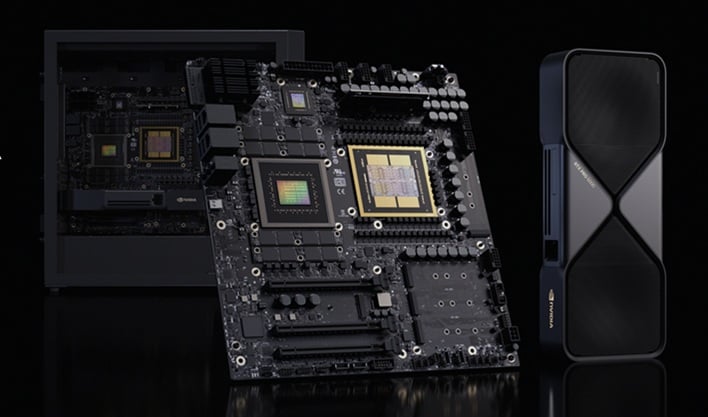
Under the hood, the machine is powered by NVIDIA's GB300 Grace Blackwell Ultra Desktop Superchip, which combines a Blackwell Ultra GPU with a 72-core Grace CPU. It packs up to 748GB of unified memory and delivers up to 20 petaflops of FP4 performance, which is the kind of spec that makes AI researchers pay attention.
For connectivity, it includes the ConnectX-8 SuperNIC with data transfer speeds up to 800Gb/s, so multiple stations can be linked together without becoming a bottleneck. If your work involves complex 3D simulations or visual tasks, you can also pair it with an RTX PRO 6000 Blackwell Workstation GPU for extra muscle. When the RTX Pro 6000 Blackwell lineup launched, it was highlighted that it sits at the top of NVIDIA's professional GPU stack and is designed for around-the-clock enterprise workloads.
The system's primary focus is what NVIDIA calls "agentic inference," which is just a fancy way of saying AI programs that run continuously in the background, automating tasks and reasoning in real time. The DGX Station can run hundreds of these agents simultaneously, and they plug directly into the Windows apps your teams already use for engineering, design, and everyday office work.
"DGX Station for Windows can serve as a dedicated AI supercomputer for a single developer or a shared local compute node for entire teams — with workloads scaling seamlessly to GB300 in the data center or cloud," NVIDIA says.
Security is an obvious concern when you're talking about autonomous AI agents operating inside a corporate network, and NVIDIA is addressing that with a new open-source runtime called NVIDIA OpenShell. It uses Windows security features to give each AI agent its own isolated sandbox, which means an agent can't reach into system policies, override security settings, or accidentally expose private data or credentials. It's a practical approach to a real problem.
For IT departments, the system is said to play nicely with existing Windows security, update, and management tools. Companies already running Linux-based AI workloads don't have to start from scratch either, since the Windows Subsystem for Linux (WSL) lets those workloads run on the same machine.
The hardware is also designed to scale, working equally well as a single developer's personal workstation or as a shared node for a whole team before larger projects eventually move to the cloud. Last year, ASUS crammed the GB300 Blackwell Ultra Superchip into a desktop workstation, which showed just how serious the push to bring this class of hardware out of the rack and onto the desk has become.
The DGX Station for Windows is expected to ship in Q4 2026. Manufacturing and distribution for the Windows version will be handled by ASUS, Dell Technologies, GIGABYTE, HP, MSI, and Supermicro.





