



NVIDIA Details How DLSS 5 Developer Controls Tame AI Over-Rendering


As we covered ahead of launch, developers can select from multiple DLSS 5 models, adjust Structure Intensity and Tone Intensity, and use both semantic AI masking as well as engine-level masks to control where the effect is applied. DLSS 5 can also make use of richer input data such as ray-traced or path-traced lighting, which NVIDIA says produces substantially more accurate results. The one particularly interesting new tidbit in this latest developer post is that Visual Concepts apparently uses a per-pixel uplift control mask in NBA 2K27 to fine-tune character detail while preserving player likenesses.

Those controls are particularly important in light of the DLSS 5 modding scene that emerged almost immediately after NBA 2K27 released. Before DLSS 5 even launched, modders extracted NVIDIA's nvngx_dlssnr.dll from the game and figured out how to inject the neural-rendering model into other titles, producing some pretty spectacular demonstrations... and some absolutely hideous ones. The difference is that these unofficial implementations don't necessarily have all of the engine-side information and developer tuning that DLSS 5 was designed around, while users can also crank the available intensity controls far beyond what a game developer would reasonably ship.

That's the thing to keep in mind when judging some of those viral DLSS 5 mod videos. Even in a photorealistic game like Yakuza, an aggressively configured or poorly integrated implementation can produce an "overcooked" image that bears little resemblance to the restrained effect NVIDIA and Visual Concepts shipped in NBA 2K27. Things get even stranger when the model is applied repeatedly to its own output. That's certainly a fun way to demonstrate what the technology can do, but it isn't representative of how DLSS 5 is intended to be integrated into a game.

There's also a more fundamental limitation: this version of DLSS 5 is trained specifically around photorealistic imagery. NVIDIA's own documentation emphasizes preserving realistic scene semantics, lighting, materials, and character identity, so simply dropping the model into a game with a deliberately stylized look isn't going to produce sensible results. That's one reason DLSS 5 mods can look particularly bizarre in games such as The Legend of Heroes: Trails of Cold Steel or Final Fantasy VII Remake. The model isn't malfunctioning; it's doing exactly what it was trained to do.
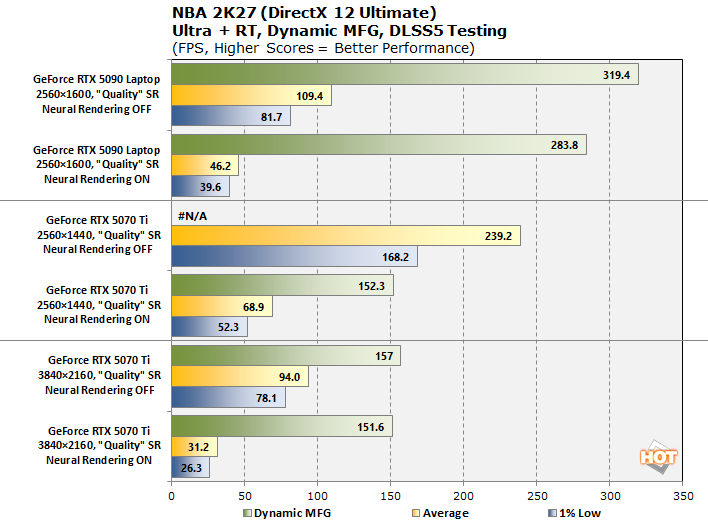
All of this also makes the "DLSS" name feel a little strange. Previous DLSS technologies are primarily reconstruction techniques designed to produce an approximation of the image the game's renderer is already trying to create, whereas DLSS 5 is a generative neural-rendering stage that applies a learned visual interpretation based on real-world data to the game's output. Where DLSS generally improved performance until now, DLSS 5 carries a rather different performance profile; in my testing, our GeForce RTX 5070 Ti went from nearly 240 FPS without DLSS 5 (capped by the engine) to under 70 FPS at 2560×1440 with it enabled, and NVIDIA recommends that resolution as a maximum for that GPU.
For developers interested in actually integrating DLSS 5 rather than simply throwing its neural model at a game and turning every slider to eleven, NVIDIA's latest technical blog is well worth a read. It provides a useful overview of the controls, masking system, input requirements, and the ways that you can constrain DLSS 5 to produce the visual results you actually want. Perhaps unintentionally, the wild world of DLSS 5 mods is already providing a pretty good demonstration of why all those controls exist in the first place.





