



NASA's Psyche Spacecraft Captures Breathtaking Mars Flyby


NASA’s Psyche spacecraft has captured a rather mesmerizing time-lapse video of Mars during its recent high-speed gravity assist flyby, offering a different view of the Red Planet’s craters, vast rust-red deserts, and polar ice caps as the probe slingshots toward its main objective: the metal-rich 16 Psyche asteroid between Mars and Jupiter.
Gathered between May 2 and May 15, the imagery shows Psyche’s close meeting with Mars. Approaching from a sharp angle relative to the Sun, the spacecraft watched Mars transform from an illuminated crescent into a swelling, detailed globe (see video above). The high-phase angle lighting also created dramatic contrasts across the Martian surface, throwing deep shadows into sprawling impact craters while illuminating the reflective carbon dioxide ice sheets guarding the planet’s poles.
While the primary objective of the flyby was for gravitational assistance (i.e. using Mars’ orbital momentum to bend Psyche’s path and slingshot it towards the main asteroid belt), the encounter served as a test for the spacecraft’s scientific instruments. Among other things, operators at NASA’s JPL used the two-week maneuver to calibrate Psyche’s twin multispectral imagers. By locking onto recognizable features across the Martian landscape, engineers verified that the cameras could accurately resolve fine surface features, track light reflections, and filter distinct wavelengths under live interplanetary conditions.
Psyche also used the flyby to trial its high-bandwidth Deep Space
Optical Communications system, demonstrating that complex visual and
high-definition time-lapse data can be transmitted across the distance back to Earth with minimal delay.
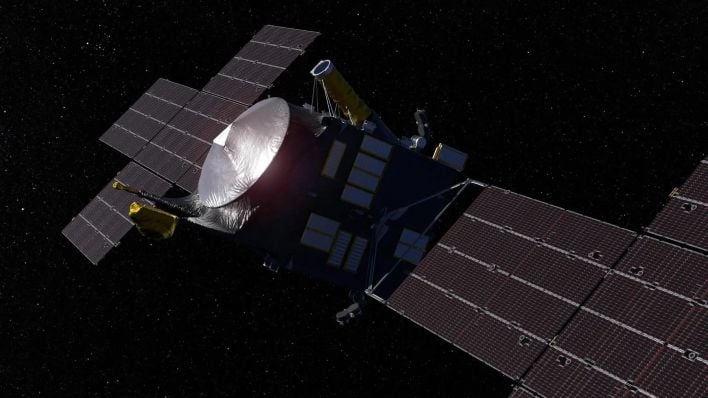
Launched in October 2023, Psyche is embarking on a 2.2-billion-mile
journey to explore its namesake, 16 Psyche, a unique metal-rich asteroid
orbiting between Mars and Jupiter. No doubt, the Mars maneuver greatly helps Psyche's orbital operations as it saves onboard propellant that can be better served at its eventual job site. Scientists suspect 16 Psyche may be
the exposed nickel-iron core of an early planetesimal that had its rocky
outer mantle stripped away by violent collisions during the birth of
the solar system. Because humanity cannot drill thousands of miles down
to inspect Earth’s own iron core, visiting 16 Psyche offers an unprecedented direct look at the building blocks of terrestrial worlds.
Main image: Mars composite image from photos taken by Psyche spacecraft between May 2-15. (Credit: NASA/JPL-Caltech/ASU)





