



Mars Flyby: NASA's Psyche Spacecraft Beams Back Ultra-Crisp Planetary Views


NASA’s Psyche spacecraft successfully utilized Mars’ gravitational pull, gaining a vital speed boost for its journey to a metal-rich asteroid while transmitting stunning, high-resolution imagery of the Red Planet.
Swooping within a mere 2,864 miles of the Martian surface, the space explorer was given a free sling shot, increasing its speed by roughly 1,000 miles per hour and subtly shifting its orbital plane by one degree relative to the Sun. This old maneuvering trick allowed Psyche to alter its trajectory while preserving vital fuel for its ultimate arrival in the main asteroid belt, expected in the summer of 2029.
While the mission team utilized the close approach primarily as a critical technical rehearsal to calibrate instruments, magnetometers, and spectrometers, the spacecraft’s multispectral imager treated Earth to a some eye-catching images.
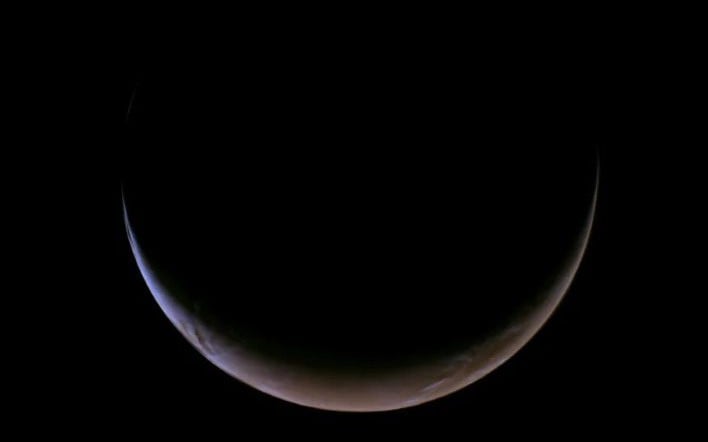
In the days leading up to the encounter, Mars appeared as a sharp, thin crescent. The curve shone brighter than expected because dust suspended in the Martian atmosphere intensely scattered the oncoming sunlight. As Psyche transitioned from the nighttime side of Mars to its sunlit face, it snapped a rapid-fire sequence of the surface.
Among the most striking images is a view of the planet’s water-ice-rich south polar cap. Spanning over 430 miles across, the frozen expanse looks almost like the eye of a swirling terrestrial storm spinning on the edge of the planet's disk. Captured at a resolution of just over a half-mile per pixel, it provides researchers with an incredibly sharp look at a highly debated region. Scientists view these layered polar caps as planetary history books, holding ancient records of dust and frozen gases that trace billions of years of Martian climate shifts.

The spacecraft also captured an enhanced-color look at the Huygens crater, a massive 290-mile-wide double-ring impact basin nestled in the heavily cratered southern highlands, alongside dramatic 30-mile-long dark wind streaks painted across the Syrtis Major region. Magnetometers on board even detected what may have been the bow shock of the planet as solar winds collided with the Martian environment.





