



NASA’s Asteroid-Smashing DART Mission Nudged A Space Rock Into A New Solar Path


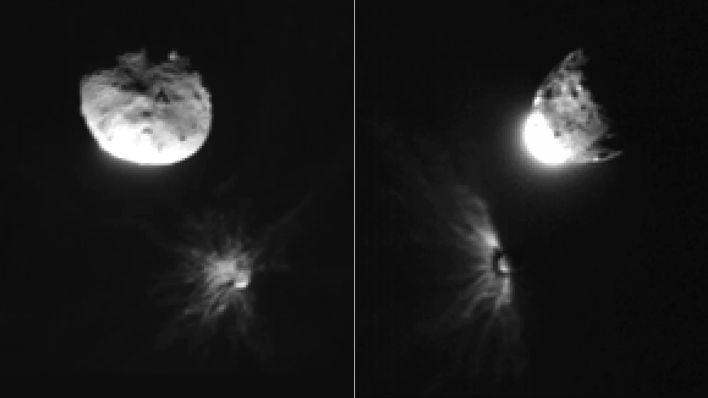
Back in 2022, NASA’s Double Asteroid Redirection Test (DART) successfully smashed a spacecraft into the asteroid moonlet Dimorphos, a kinetic impact experiment to see if we could knock a lethal space rock off course. New analysis this week reveals that the impact did make a difference and that DART altered the entire binary asteroid’s path around the sun, which bodes well for future planetary defense systems.

While previous data focused on how Dimorphos’s orbit around its larger partner, Didymos, shortened by 33 minutes, the latest findings (published in Science Advances) track the heliocentric change, or rather the duo’s collective journey around the sun. Scientists found that the collision slowed the system’s orbital speed by approximately 11.7 microns per second. While that shift is roughly equivalent to 1.7 inches per hour, such a minuscule change compounded over years of travel can translate into a deflection of thousands of miles, potentially making the difference between a direct hit and a safe pass for a future Earth-bound threat.
These findings also relied on an unconventional source: between 2022 and 2025, dozens of volunteer amateur astronomers across the globe tracked 22 stellar occultations, moments where the Didymos system passed in front of distant stars. By timing these flickers of light, one could pinpoint the asteroids’ positions precisely. This ground-based data, combined with NASA’s Deep Space Network plus ground- and space-based telescopes, allowed the team to better predict the orbital shift.
These results confirm that we do not necessarily need massive Hollywood-style nuclear weapons or futuristic technology to protect the planet; rather, we just need time and a well-placed nudge. Of course, the biggest key for success is detecting hazardous Earth-bound object years or decades in advance. With that kind of headroom, a relatively small spacecraft like DART can provide the slight course correction needed to ensure the rock misses us entirely.





