



NASA Captures Stunning High-Res Images Of Comet 3I/Atlas Zipping Past Mars


Continuing our coverage of is-it-an-alien-spacecraft Comet 3I/ATLAS, an armada of space missions (including Hubble, JWST, plus assets orbiting and roving on Mars) have captured the comet's fleeting flyby of Mars before it disappears forever. And no, it's not extraterrestrial: the icy wanderer was likely ejected from its home star’s orbit millions of years ago, drifting at 137,000 miles per hour, too fast for the Sun's gravity to keep it within the solar system.
NASA officials were consequently quick to squash ongoing alien rumors (made stronger by periods when official communication was paused), emphasizing that while its origin is exotic, "it looks and behaves like a comet," according to Amit Kshatriya, NASA’s associate administrator. Kshatriya stressed that its extrastellar origin is what makes it "fascinating, exciting, and scientifically very important."
Early data already shows a carbon dioxide-to-water ratio that differs significantly from typical solar system comets, alongside unusual amounts of metals and distinct dust features. Nicky Fox, associate administrator for the science mission directorate, encapsulated the enthusiasm, noting, "It’s going to look different because it didn’t come from our solar system. And that’s what makes it so magical."
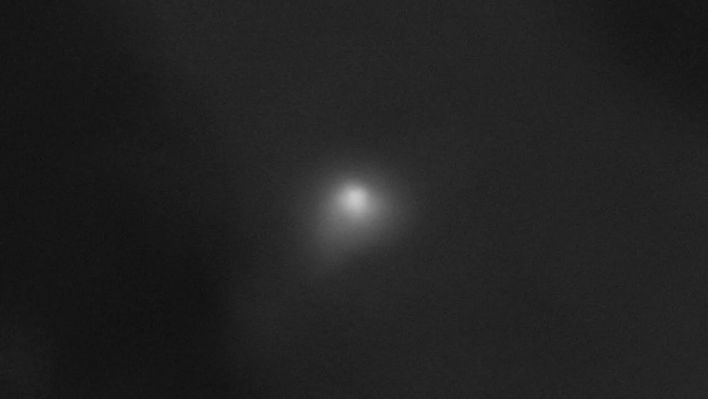
The most critical views were secured at the beginning of October with NASA’s Mars Exploration Program spacecraft. The Mars Reconnaissance Orbiter (MRO) utilized its HiRISE camera—normally pointed at the Martian surface—to pivot and snap one of the closest pictures of 3I/ATLAS any instrument will capture. Taken from 19 million miles away, the image (above) shows the comet's coma vaporizing off its surface, which scientists will use to estimate the size of the central nucleus.
Meanwhile, the MAVEN (Mars Atmosphere and Volatile EvolutioN) orbiter employed its imaging ultraviolet spectrograph (IUVS) to study the comet’s composition and found hydrogen and hydroxyl in its coma. This data will be vital in determining the ratio of deuterium to regular hydrogen—a key chemical tracer that can definitively reveal the object’s birthplace and evolutionary path.
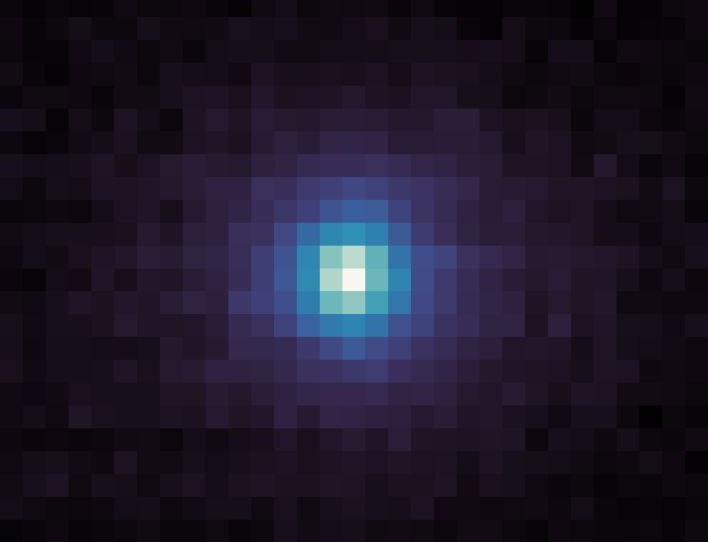
Even the Perseverance rover (currently in the Jezero Crater) got in on the action: it snapped a faint long-exposure image of the comet using its Mastcam-Z camera. Elsewhere, the Hubble and James Webb Space Telescopes, along with the Lucy and Psyche missions, also joined the viewing party. Tom Statler, lead scientist for solar system small bodies, summarized the challenge of coordinating these instruments saying, "It's a little bit as if our NASA spacecraft were at a baseball game, watching the game from different places in the stadium. Everybody has got a camera, and they’re trying to get a picture of the ball, and nobody has a perfect view, and everybody has a different camera."
Photo credits: NASA





