



Modder Unleashes MSI RTX 5090 1000W Power BIOS On Other Graphics Cards


The Lightning Z is designed for extreme power delivery, with dual 12V-2×6 connectors and separate voltage regulation for each power input, backed by firmware that allows power limits in the 800W to 1000W range. On its own hardware, that design is at least internally coherent: the electrical load is split across two connectors and VRM paths that were explicitly engineered for that kind of abuse.
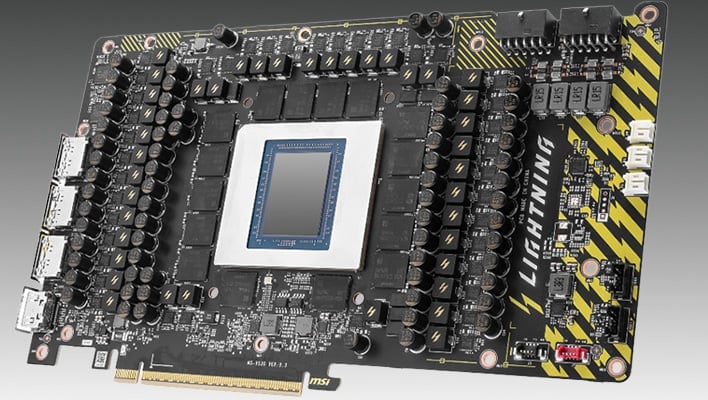
The absurdity begins when that same BIOS is flashed onto standard RTX 5090 cards that only have a single 12V-2×6 connector and a completely different power-delivery layout. The RTX 5090's real-world power draw regularly pushes past 600W on overclocked cards, and small imbalances in pin resistance can turn into localized hotspots very quickly. That's why tools like Thermal Grizzly's WireView2 have become almost mandatory for extreme overclockers, as they provide external, connector-level power measurements precisely because relying on software telemetry alone has proven insufficient.

Which brings us to Overclock.net user yzonker, one of the very first to publicly report results from flashing the Lightning Z BIOS onto an ASUS ROG Astral RTX 5090. Early screenshots looked promising, including GPU crossbar clocks touching 2.7 GHz. However, with the MSI BIOS flashed, his ROG Astral 'White' card never actually exceeds about 700W of real power draw as measured by a WireView2, despite software reporting figures north of 1300W. In other words, the BIOS boots, the limits appear unlocked, but the underlying power delivery and telemetry don't line up. The result is inflated reported wattage without corresponding performance gains.
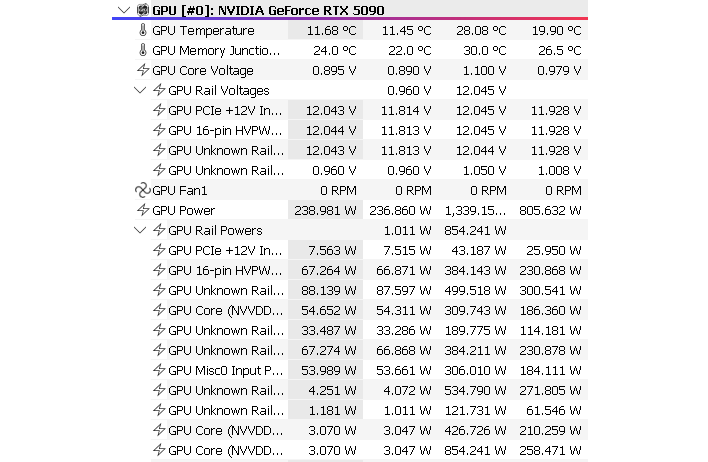
The overclocker actually noted that ASUS' own ROG Matrix BIOS delivered better results overall—at least without hardware modification, and several other users have chimed in on the thread to report the same thing. For unmodified, single-power-connector cards, the ROG Matrix BIOS still seems to be king. It makes sense considering the differences in power delivery design. That firmware is tuned for aggressive power behavior on ASUS's flagship board, and without a shunt mod that physically alters the VRM so the GPU "thinks" it's drawing less power than it really is, the Lightning Z BIOS doesn't seem to offer meaningful advantages so far.
But really, all of this underlines the absurdity of the experiment. The Lightning Z is built around assumptions that simply aren't true for most RTX 5090 boards, starting with dual 12V-2×6 connectors and a VRM designed to survive four-digit wattage. Transplanting its BIOS onto cards with single connectors and different power layouts doesn't magically turn them into a $5,000 halo product; mostly, it turns them into very expensive stress tests for already-strained power connectors.
We have no doubt that some mad lad will make use of this BIOS on a card that was never meant for it along with modified power delivery and LN2 cooling to compete with the MSI Lightning model for world records, although we do have to wonder if matching MSI's most mighty graphics card is truly possible. There's also the "what is even the point of this anymore," argument, but, well—that's never stopped overclockers before.
Thanks to Uniko's Hardware for the spot!





